
Table of Contents
- 1. Why Hybrid Teams Broke Traditional Attendance Systems?
- 2. How Does AI Facial Recognition Attendance Work?
- 3. The Indian Market Shift: Why Facial Recognition Adoption Is Accelerating
- 4. Addressing the Big Question: Is Facial Recognition Attendance Legal in India?
- 5. How Does Facial Recognition Attendance Help Hybrid Teams?
- 6. How Does DigiSME Support Facial Recognition Attendance?
- 7. Facial Recognition Attendance FAQs
When Attendance Became the Weakest Link in Hybrid Work-AI-Powered Facial Recognition Stepped In
Many Indian HR teams realised something uncomfortable. Hybrid work wasn’t failing — attendance systems were.
Employees were logging in from home on Mondays, working from the office on Wednesdays, and stepping out for client meetings on Fridays. Traditional attendance tools — biometric devices at office entrances or manual punch-ins — simply couldn’t keep up with this fluid reality. Payroll disputes increased. Compliance audits took longer. HR teams spent hours reconciling data that should have been automatic.
This is where AI-powered facial recognition quietly started changing the rules of attendance management in India.
Not as a futuristic concept — but as a practical response to hybrid workforce chaos.
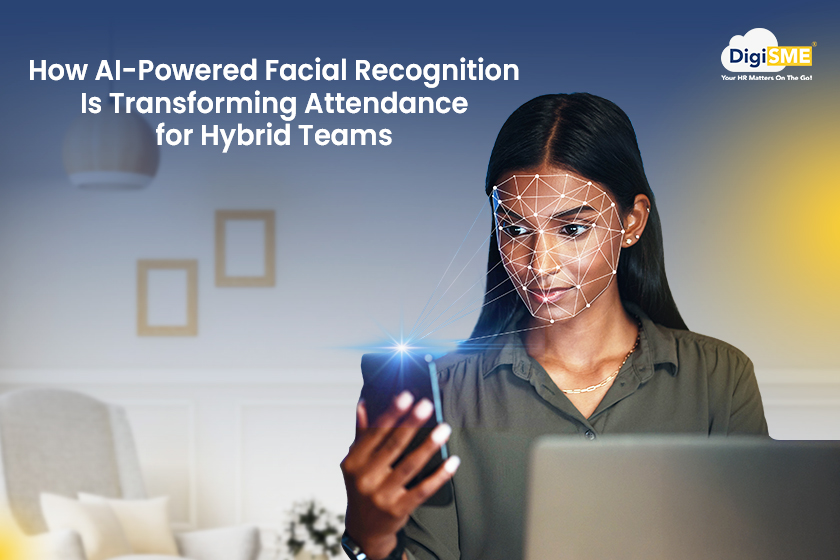
| AI-powered facial recognition allows hybrid teams to mark attendance securely from approved locations without physical devices. |
Why Hybrid Teams Broke Traditional Attendance Systems?
For years, Indian organisations relied on biometric attendance systems built for a single assumption: employees come to the office every day. Hybrid work dismantled that assumption overnight.
Office-only biometric machines struggled with:
- Incomplete attendance records for remote days
- Proxy punch risks when teams shared devices
- Zero visibility into offsite or field-based work
- Manual corrections before payroll processing
According to NASSCOM, over 58% of Indian mid-to-large enterprises now operate hybrid or flexible work models. Attendance tools that cannot verify who worked, where, and when in a hybrid environment directly affect payroll accuracy, statutory compliance, and employee trust.
This gap created fertile ground for facial recognition–based attendance systems powered by AI.
How Does AI Facial Recognition Attendance Work?
Unlike legacy biometric attendance systems that depend on fingerprint sensors or fixed hardware, AI facial recognition attendance uses computer vision algorithms to verify identity through facial features. Here’s what changed technically — and why it matters for HR.
AI models analyse facial features such as eye distance, contour patterns, and micro-expressions rather than storing raw images. This significantly reduces spoofing risks and allows verification through mobile devices, laptops, or office kiosks.
In practical terms, this means:
- Employees can mark attendance from approved locations
- Identity verification happens in seconds
- Attendance logs sync instantly with payroll systems
- HR gains real-time visibility across hybrid teams
This shift aligns closely with India’s Digital Personal Data Protection Act (DPDP Act, 2023), which emphasises purpose-limited data usage and secure processing — especially when biometric or facial data is involved.
The Indian Market Shift: Why Facial Recognition Adoption Is Accelerating
The rise of facial recognition attendance in India is not happening in isolation. It is being driven by three very real market forces in India.
· Compliance Pressure Is Increasing
Indian labour compliance is becoming more data-driven. Payroll audits now expect clean attendance trails that match wage calculations, overtime, and statutory filings. It reduces human intervention, lowering error rates and audit risks.
· Hardware-Heavy Systems Are Losing Relevance
Post-pandemic, companies are reluctant to invest in expensive biometric machines that only work inside offices. AI-powered facial recognition systems operate through existing devices, making them cost-effective and scalable — especially for growing SMEs.
· Employee Experience Is Now a Priority Metric
Employees expect attendance tools to be frictionless. No queues, No repeated scans, No awkward shared devices. Attendance feels invisible — which is precisely why it works.
Gartner’s HR technology research highlights that low-friction employee systems improve adoption rates by over 30% in distributed teams.
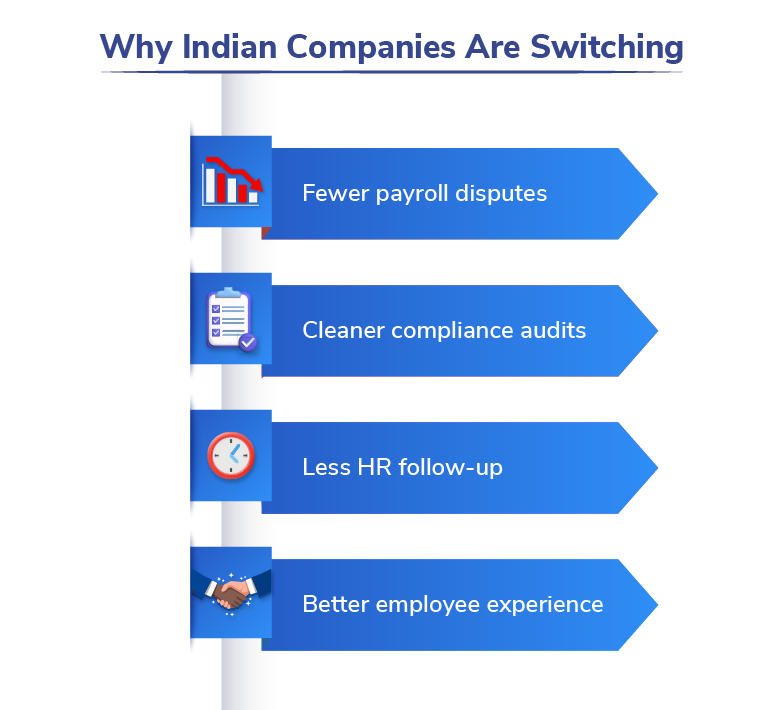
| Facial recognition attendance systems reduce payroll errors by ensuring real-time, identity-verified attendance data. |
Addressing the Big Question: Is Facial Recognition Attendance Legal in India?
This is one of the most searched questions in India’s HR tech space — and rightly so.
Facial recognition attendance is legal in India when implemented responsibly. Under the DPDP Act:
- Explicit employee consent is mandatory
- Data must be collected for a clear business purpose
- Storage must be secure and limited
- Employees must be informed of usage and retention policies
Reputable HRMS platforms design facial recognition features with consent workflows, encryption, and audit controls built in. When done correctly, this attendance is not only compliant — it is often more defensible than loosely managed biometric systems.
| When implemented with consent and security controls, facial recognition attendance is compliant with India’s DPDP Act. |
How Does Facial Recognition Attendance Help Hybrid Teams?
For hybrid teams, the real transformation is not technical. It’s operational.
Attendance becomes location-agnostic but identity-locked.
HR teams no longer chase employees for corrections.
Payroll teams trust the data flowing into salary calculations.
Consider a mid-sized IT services firm with hybrid delivery teams across Bengaluru, Pune, and remote locations. With facial recognition attendance integrated into their HRMS:
- Employees authenticate attendance via mobile apps
- Geo-fencing ensures location policy compliance
- Attendance feeds directly into payroll and leave systems
- HR dashboards show real-time workforce presence
This eliminates the disconnect between attendance, payroll, and compliance — a recurring theme across DigiSME’s HRMS content library.
How Does DigiSME Support Facial Recognition Attendance?
DigiSME’s HRMS approach reflects a broader industry shift: attendance is no longer a standalone feature. It is part of a connected workforce ecosystem.
By integrating AI-powered facial recognition within attendance, payroll, and compliance workflows, DigiSME enables organisations to:
- Maintain accurate attendance across hybrid teams
- Reduce payroll discrepancies
- Strengthen audit readiness
- Improve employee experience without invasive monitoring
Rather than selling it as a “feature”, DigiSME positions it as a business continuity tool for modern Indian workplaces.
Conclusion: Attendance That Finally Matches How India Works Today
Hybrid work is no longer an experiment. It is the default.
AI-powered facial recognition brings attendance systems back in sync with reality — flexible, compliant, and human-centric. For HR leaders, finance teams, and business owners, it removes friction from one of the most sensitive workforce processes.
As Indian organisations rethink how they manage people in a hybrid world, attendance is no longer about control.
It’s about clarity, trust, and continuity.
Contact Us For A Free Demo!
Facial Recognition Attendance FAQs
Is facial recognition attendance safe for employees?
Yes. Modern facial recognition systems use encrypted facial mapping rather than storing raw images. When combined with consent and access controls, they are often safer than traditional biometric attendance systems.
Can facial recognition work for remote employees?
Absolutely. Facial recognition attendance systems are designed for mobile and cloud environments, making them ideal for hybrid and remote teams with location policies in place.
Does facial recognition replace biometric attendance systems?
In many cases, yes. Organisations are shifting away from hardware-dependent biometric attendance systems toward AI-based facial recognition for flexibility and scalability.
Is facial recognition attendance compliant with Indian labour laws?
Yes, when implemented with employee consent, transparent policies, and secure data handling in line with India’s DPDP Act and labour regulations.
How does facial recognition improve payroll accuracy?
By eliminating proxy attendance, manual corrections, and data gaps, it ensures clean attendance data flows directly into payroll calculations.
