Payroll errors may look small, but they can quickly turn into costly compliance issues. Studies by Ernst & Young (EY) show that around 20% of payroll runs contain errors, and each mistake costs businesses an average of approximately $291, excluding penalties, corrections, and operational delays.
In India, the impact is even more serious because payroll is directly linked with strict statutory systems like PF, ESI, and TDS, each governed by fixed deadlines and penalties under labour and tax laws. As a result, even a small mistake can lead to compliance risks and financial penalties.
Moreover, most payroll mistakes companies make do not happen during salary calculation. Instead, they start much earlier—when attendance data is incomplete, employee records are incorrect, or salary structures are not properly defined.
Because of this, common payroll errors in India are not just operational issues. They are compliance risks that can lead to penalties, audit issues, and employee dissatisfaction if they are not controlled through a structured payroll process checklist and proper automation.
What are payroll mistakes?
Payroll mistakes are errors that occur during the process of calculating, processing, or managing employee salaries. These include incorrect salary calculations, wrong tax deductions, missed statutory payments like PF, ESI, and TDS, or inaccurate employee data such as bank details and attendance records. Typically, these errors happen due to manual processes, disconnected systems, or a lack of proper approval workflows.
Why Payroll Mistakes Happen in Companies
Understanding common payroll errors in India is essential for building a compliant and scalable payroll system. In most cases, payroll issues arise not from calculation complexity but from fragmented systems, manual dependencies, and missing validation checkpoints. As organizations grow, these gaps begin to impact PF, ESI, and TDS payroll compliance, employee satisfaction, and financial accuracy.
Research shows that nearly 49% of HR teams spend over 5 hours per month correcting payroll errors, instead of focusing on strategic HR activities, highlighting how inefficient payroll systems slow down business performance. As a result, these challenges often turn into recurring issues unless companies actively identify and fix them at the root level.
Core Payroll Mistakes Companies Make and How to Avoid Them
To understand where companies go wrong, it is important to break down the most critical payroll mistakes in organizations and how they can be prevented. In fact, these issues directly impact payroll accuracy, statutory compliance, employee trust, and overall cost efficiency.
Payroll Mistake #1: Attendance and Payroll Not Integrated
One of the most frequent payroll mistakes in India occurs when attendance and payroll systems are not connected. As a result, when attendance data is maintained separately and payroll is calculated manually, every salary cycle turns into a reconciliation process.
This leads to:
- Incorrect overtime calculations
- Manual leave adjustments
- Loss of Pay (LOP) inconsistencies
- Salary mismatches between similar roles
How to Avoid This:
Therefore, integrate attendance, leave, and shift rules directly into the payroll system. Additionally, ensure attendance is locked before payroll processing begins to eliminate manual intervention and calculation errors.
Payroll Mistake #2: Incorrect Employee Master Data
Employee master data forms the foundation of payroll accuracy, yet it is often poorly maintained. Even then, minor errors in PAN, UAN, bank details, or employment category can disrupt salary processing.
This results in:
- Salary credit failures or delays
- Incorrect PF, ESI, and TDS deductions
- Compliance filing errors
- Reconciliation rework
How to Avoid This:
To prevent this, implement structured onboarding with mandatory field validation. Moreover, all employee data changes should go through an approval workflow and a pre-payroll verification step.
Payroll Mistake #3: Poor Salary Structure Design
Improper salary structuring is a hidden cause of recurring payroll issues. In such cases, when salary components are not aligned with statutory rules, payroll inconsistencies become unavoidable.
This leads to:
- PF/ESI miscalculations
- Unstable TDS deductions
- Inconsistent bonuses and allowances
- Compliance issues during audits
How to Avoid This:
Hence, standardize salary structures across employee categories. At the same time, each component must be mapped to statutory rules, and any exceptions should be controlled through system configuration.
Payroll Mistake #4: Missing PF, ESI, TDS Deadlines
Compliance delays are among the most serious payroll risks because they directly lead to penalties and legal exposure. For instance, key requirements include:
- PF monthly filings within deadlines
- ESI submissions on time
- Timely TDS deductions and deposits
Missing these results in avoidable payroll penalties and audit issues.
How to Avoid This:
To address this, maintain a statutory compliance calendar within the payroll system. Furthermore, assign clear ownership, enable automated reminders, and validate compliance before submission.
Payroll Mistake #5: Weak Payroll Audit System
Without a strong audit trail, payroll becomes difficult to verify and control. However, many organizations still rely on emails and spreadsheets for approvals.
This leads to:
- No accountability for salary changes
- Lack of approval traceability
- Audit and dispute challenges
- Weak payroll governance
How to Avoid This:
Instead, use a system-based audit framework where every payroll action is logged with timestamps, user details, and approval hierarchy. Finally, lock payroll versions before disbursement.
Payroll Mistake #6: Manual Overtime & Shift Calculation
Manual handling of overtime and shift allowances creates frequent payroll inconsistencies, especially in shift-based industries like manufacturing, logistics, and retail. Consequently, this results in:
- Incorrect overtime payouts
- Shift allowance inconsistencies
- Manual LOP calculation errors
How to Avoid This:
Thus, define overtime, shift, and leave policies directly within the payroll system. In addition, automate calculations to ensure consistent rule application.
Payroll Mistake #7: Incorrect Full & Final Settlement
Full and Final (FnF) settlement errors often impact employee trust more than regular payroll mistakes due to their sensitivity at exit stage. Typically, common issues include:
- Leave encashment errors
- Incorrect notice period deductions
- Missing reimbursements
- Tax miscalculations
How to Avoid This:
Therefore, follow a structured FnF workflow integrated with HR and payroll systems. Also, use multi-level approvals before final settlement.
Payroll Mistake #8: Overdependence on Spreadsheets
Spreadsheets are flexible but risky for payroll processing at scale. As companies grow, manual file-based payroll becomes error-prone.
This causes:
- Version control issues
- Formula errors affecting salaries
- No audit trail
- High dependency on individuals
How to Avoid This:
Hence, shift to a centralized payroll system with automation, validation rules, and compliance tracking. In contrast, use spreadsheets only for reporting, not processing.
Payroll Compliance Checklist for Companies in India
A strong payroll compliance checklist India businesses follow is not just about ticking tasks—it is about ensuring every payroll cycle is legally correct, audit-ready, and error-free. However, most payroll mistakes companies make happen when compliance steps are rushed, skipped, or handled without a fixed system.
Below is a structured monthly payroll compliance flow designed to reduce common payroll errors in India and help companies stay aligned with PF, ESI, and TDS regulations.
Attendance and Payroll Data Finalization
Before payroll processing begins, attendance data must be fully captured and locked. This includes shift records, overtime entries, approved leave, and any Loss of Pay adjustments. In fact, any mismatch at this stage directly leads to payroll calculation errors, so this step acts as the first control point in the payroll process checklist.
Employee Master Data Verification
All employee records must be validated before salary computation. This includes bank account details, PAN information, UAN status, salary structure mapping, and employment category updates. As a result, errors in this stage often result in PF, ESI, TDS payroll mistakes and delayed salary credits.
Salary Structure and Component Validation
Salary components must be reviewed for compliance alignment. Basic pay, allowances, deductions, reimbursements, and statutory contributions should follow approved structures. Therefore, poor configuration here is a leading cause of salary compliance India issues during audits and monthly reconciliation.
Statutory Deduction Accuracy Check
PF, ESI, and TDS calculations must be verified against current thresholds and rules. Even a minor misalignment in wage mapping or exemption logic can lead to penalties. This step ensures all statutory deductions are accurate before final payroll approval.
Payroll Preview and Internal Review
A full payroll preview must be generated and reviewed by both HR and finance teams. This helps identify anomalies in salary variations, unexpected deductions, or missing entries before final processing. This review stage is critical for maintaining a reliable payroll audit checklist India standard.
Compliance Deadline Tracking
Every payroll cycle must be aligned with statutory deadlines. PF filings, ESI contributions, and TDS deposits must be scheduled and tracked within defined due dates. Otherwise, missing these timelines is one of the most common reasons companies face avoidable payroll penalties India regulations enforce.
Reimbursements and Claims Approval
All employee reimbursements, incentives, and claims must be verified and approved before payroll finalization. At the same time, uncontrolled reimbursements often create discrepancies in total payroll outflow and lead to reporting mismatches.
Final Payroll Reconciliation
After payroll processing, a reconciliation check ensures that salary outputs match approved inputs. In addition, this includes comparing attendance data, deductions, and statutory filings to ensure consistency across all records.
Payslip Generation and Distribution
Payslips must be generated only after payroll is fully approved and locked. Employees should receive transparent breakdowns of earnings, deductions, and statutory contributions to maintain trust and compliance clarity.
Post-Payroll Compliance Filing
After salary disbursement, statutory filings for PF, ESI, and TDS must be completed within deadlines. Finally, this step ensures the organization remains compliant with labor and tax regulations while maintaining audit readiness for future inspections.
| Payroll Mistake | What Goes Wrong | Simple Fix |
| Attendance errors | Wrong working hours or missing data | Connect attendance with payroll system |
| Employee data mistakes | Wrong PAN, bank, or UAN details | Use validated onboarding forms |
| Salary structure issues | Incorrect salary breakup | Standard salary templates |
| Missed PF/ESI/TDS | Late or wrong deductions | Automated compliance system |
| Manual payroll processing | Calculation errors | Use payroll software |
| No approval system | Untracked salary changes | Set digital approval workflow |
| Spreadsheet dependency | Version and formula errors | Switch to HRMS system |
| Poor FnF settlement | Wrong final payout | Automated FnF calculation |
How Payroll Software Reduces These Risks and Improves Compliance Accuracy
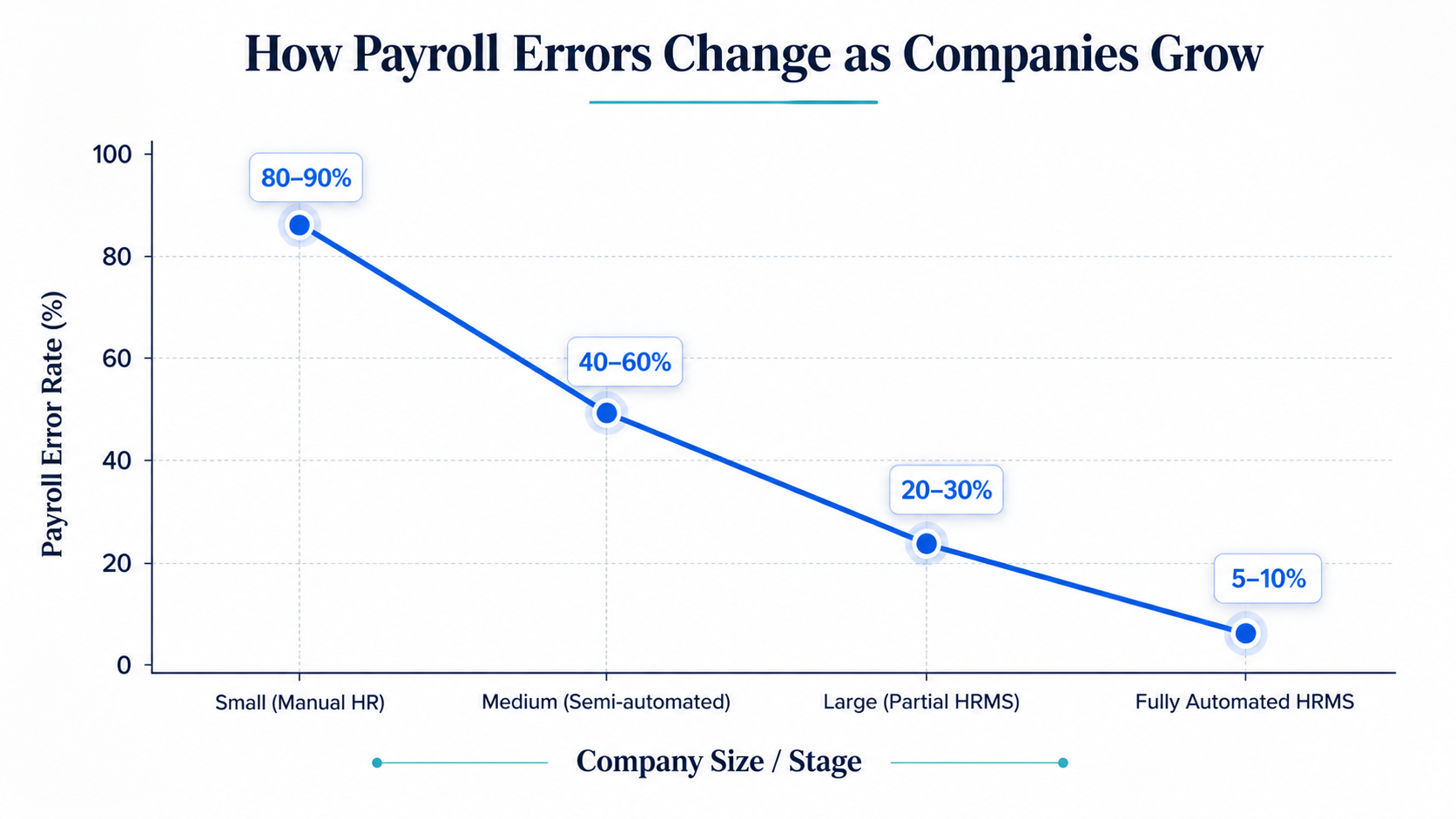
Most payroll mistakes companies make are not due to lack of effort—they happen because systems are disconnected, manual, or dependent on spreadsheets. As a result, as compliance complexity increases in India with PF, ESI, and TDS payroll rules, manual payroll processes become difficult to manage consistently.
Studies from leading HR transformation research indicate that automated payroll systems can reduce payroll processing errors by 30%–40% compared to manual systems, improving accuracy, compliance, and operational efficiency. Therefore, this is where modern payroll software changes the entire workflow by converting payroll from a reactive task into a controlled, automated compliance system.
1. Eliminates Manual Errors Through Automation
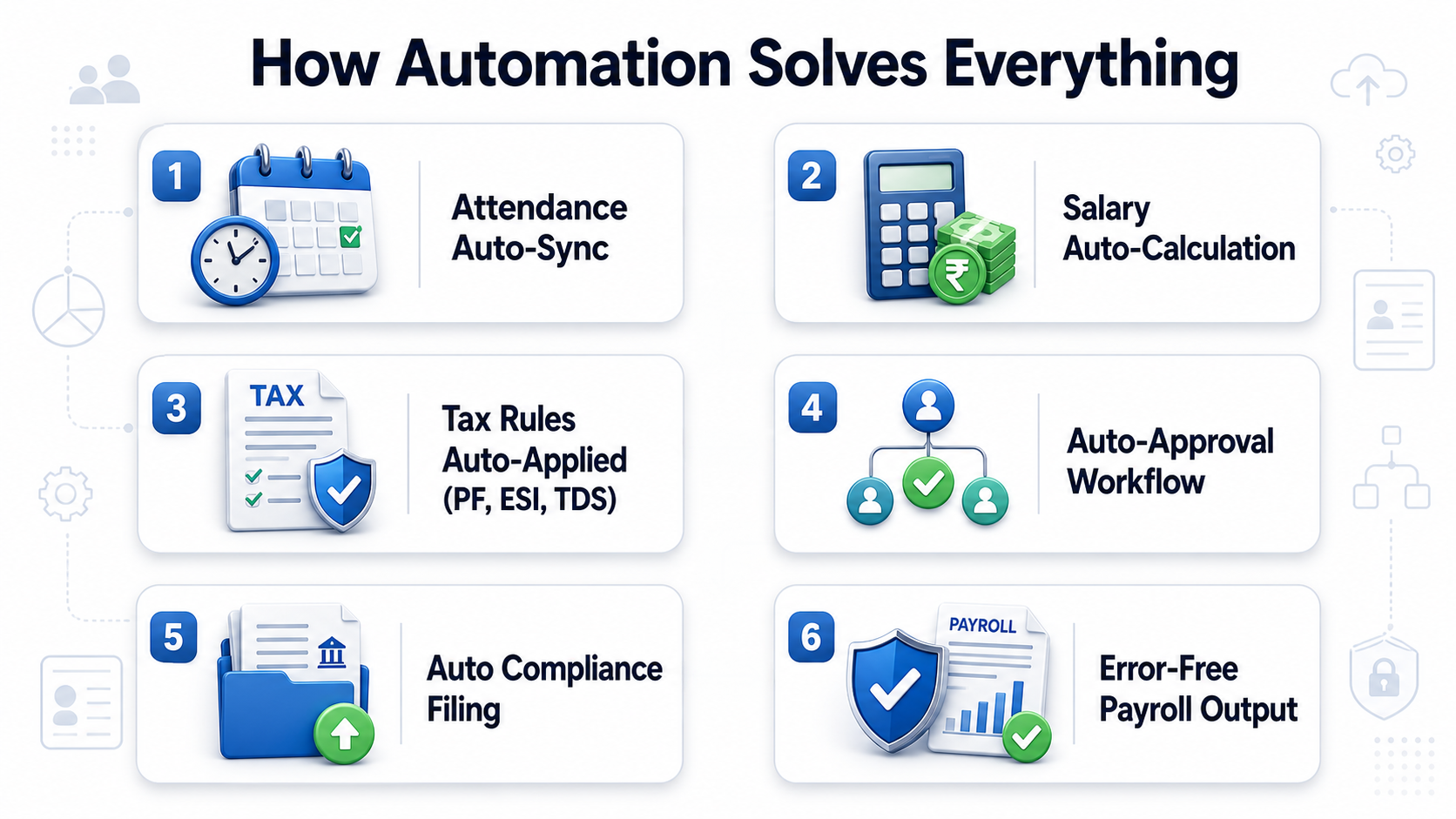
Payroll software removes dependency on manual calculations, which is the biggest source of common payroll errors in India. Instead of this, HR teams calculating salaries line by line, the system automatically:
- Computes gross-to-net salary
- Applies PF, ESI, and TDS rules correctly
- Adjusts for attendance, leave, and LOP
- Applies overtime and shift rules consistently
As a result, this significantly reduces payroll calculation errors and ensures every employee is processed using the same logic.
2. Connects Attendance, HR, and Payroll in One Flow
One of the major reasons for payroll mistakes India companies face is system fragmentation. Modern platforms like DigiSME HRMS solve this by integrating:
- Attendance tracking
- Leave management
- Payroll processing
- Expense and reimbursement workflows
In addition, with DigiSME, attendance data flows directly into payroll without manual intervention, ensuring that salary is always calculated on verified and approved inputs. This removes mismatches that usually cause recurring payroll process checklist failures.
3. Built-in PF, ESI, and TDS Compliance
Instead of manually tracking statutory rules, payroll software automatically updates compliance logic based on regulations.
As a result, this helps avoid:
- Incorrect PF contribution calculations
- ESI eligibility mistakes
- TDS deduction errors
- Late filings and penalties
DigiSME and similar systems are designed to align with Indian statutory frameworks, reducing the risk of avoid payroll penalties India scenarios caused by missed deadlines or miscalculations.
4. Strong Audit Trails and Approval Workflows
A major gap in manual payroll systems is the lack of transparency. To address this, payroll software solves this by creating:
- Step-by-step approval flows
- Time-stamped audit logs
- Role-based access control
- Version history of payroll runs
As a result, this strengthens the payroll audit checklist India compliance standard and ensures every salary change is traceable. It also eliminates confusion during audits or internal reviews because every action is recorded in the system.
5. Real-Time Error Detection and Validation
Instead of discovering errors at month-end, payroll systems flag issues in real time:
- Missing employee data
- Invalid bank or PAN details
- Attendance mismatches
- Salary structure inconsistencies
Consequently, this proactive validation reduces common payroll errors in India before they reach the final payroll stage.
6. Simplifies Full & Final Settlement Process
Exit management is one of the most error-prone areas in payroll. However, with automation, systems like DigiSME streamline FnF by:
- Auto-calculating leave encashment
- Applying notice period rules
- Handling recoveries and reimbursements
- Generating final settlement reports
As a result, this reduces disputes and improves accuracy during employee exits.
7. Employee Self-Service Reduces Dependency
Payroll software also improves efficiency by allowing employees to:
- Download payslips
- Submit tax declarations
- Update personal details
- Track reimbursements
In turn, this reduces HR dependency and minimizes manual errors caused by repeated data requests.
Final Verdict
Payroll mistakes are rarely calculation issues—they are system issues. Most common payroll errors in India, such as incorrect attendance mapping, salary miscalculations, and missed PF, ESI, and TDS compliance, happen due to manual processes and disconnected tools.
Therefore, to reduce payroll mistakes companies make, businesses need automation, structured approvals, and real-time compliance tracking. This is where DigiSME HRMS helps by connecting attendance, leave, payroll, and statutory compliance in one system. It reduces manual effort, improves accuracy, and ensures every payroll step is rule-based and traceable.
With built-in compliance tracking and audit trails, DigiSME helps companies shift from reactive payroll corrections to a controlled, error-free process—reducing risks and ensuring smoother payroll operations every month.
Frequently Asked Questions
What are payroll mistakes?
Errors in salary calculation, compliance, or employee data management.
Why do payroll mistakes happen?
Due to manual processes, poor systems, and missing validation.
How do payroll mistakes impact companies?
They cause penalties, salary disputes, and compliance risks.
Can payroll software reduce errors?
Yes, automation can reduce errors by 30%–40% or more.
