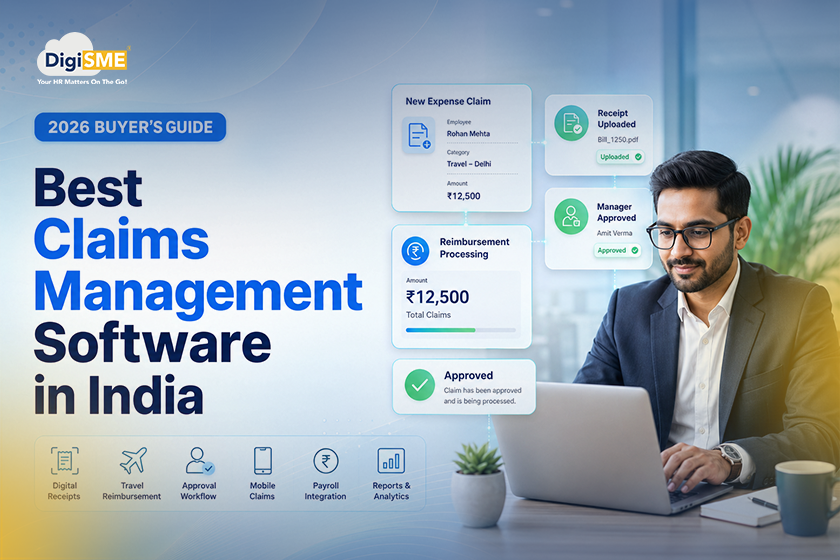
Managing employee expense claims may seem simple, but for many businesses, it becomes time-consuming and error-prone. Paper receipts get misplaced, approvals are delayed, reimbursement errors increase, and finance teams spend valuable time verifying claims manually. As a result, as businesses grow, these challenges affect productivity, compliance, and employee satisfaction.
The Best Claims Management Software in India helps automate the entire reimbursement process—from claim submission and receipt verification to approval workflows and payroll integration. Additionally, features like OCR receipt scanning, automated policy checks, mobile claim submission, and real-time tracking improve accuracy while reducing manual work. In this guide, you’ll learn how Claims Management Software works, the key features to look for, compare the best solutions in India, and choose the right software for your business.
What is Claims Management Software?
Managing employee reimbursements shouldn’t require endless emails, spreadsheets, or paper receipts. Claims Management Software is a centralized platform that helps organizations digitally manage the complete expense reimbursement process—from claim submission and verification to approvals, reimbursement, and record keeping.
Instead of relying on manual processes, employees can submit expense claims online, upload receipts, and track their reimbursement status in real time. Meanwhile, managers receive claims for approval through predefined workflows, while finance teams can verify expenses, enforce company policies, and maintain accurate records for audits and compliance. Moreover, whether it’s a startup with a small workforce or a large enterprise handling thousands of claims every month, the Best Claims Management Software in India helps reduce administrative work, improve accuracy, and speed up reimbursements.
How Does Claims Management Software Work?
Managing employee reimbursements shouldn’t be a complicated process. However, many businesses still rely on emails, spreadsheets, and paper receipts, making expense tracking slow and difficult. As a result, Claims Management Software simplifies this by automating every stage of the reimbursement process—from claim submission to final payment. Instead of manually verifying receipts and following up for approvals, employees, managers, and finance teams can collaborate through a single platform. Therefore, this reduces paperwork, speeds up approvals, improves policy compliance, and gives complete visibility into every expense claim.
A Typical Claims Reimbursement Process
Step 1: Employee Submits a Claim
Employees submit their business expenses through a web portal or mobile app by uploading bills and receipts.
Step 2: Receipt Details Are Captured
Next, the software uses OCR (Optical Character Recognition) to automatically read details such as the vendor name, bill amount, date, GST information, and expense category.
Step 3: Expense Policy Validation
Then, the system checks whether the submitted claim complies with the organization’s reimbursement policies and spending limits.
Step 4: Approval Workflow
After that, claims are automatically routed to the appropriate reporting manager or approver based on predefined approval rules.
Step 5: Finance Verification
Once approved, the finance team reviews the claim and verifies the supporting documents before reimbursement.
Step 6: Reimbursement Processing
After verification, the approved amount is transferred through payroll, accounting software, or the organization’s ERP system.
Step 7: Digital Record Maintenance
Finally, every transaction is securely stored with a complete audit trail, making reporting and future audits much easier.
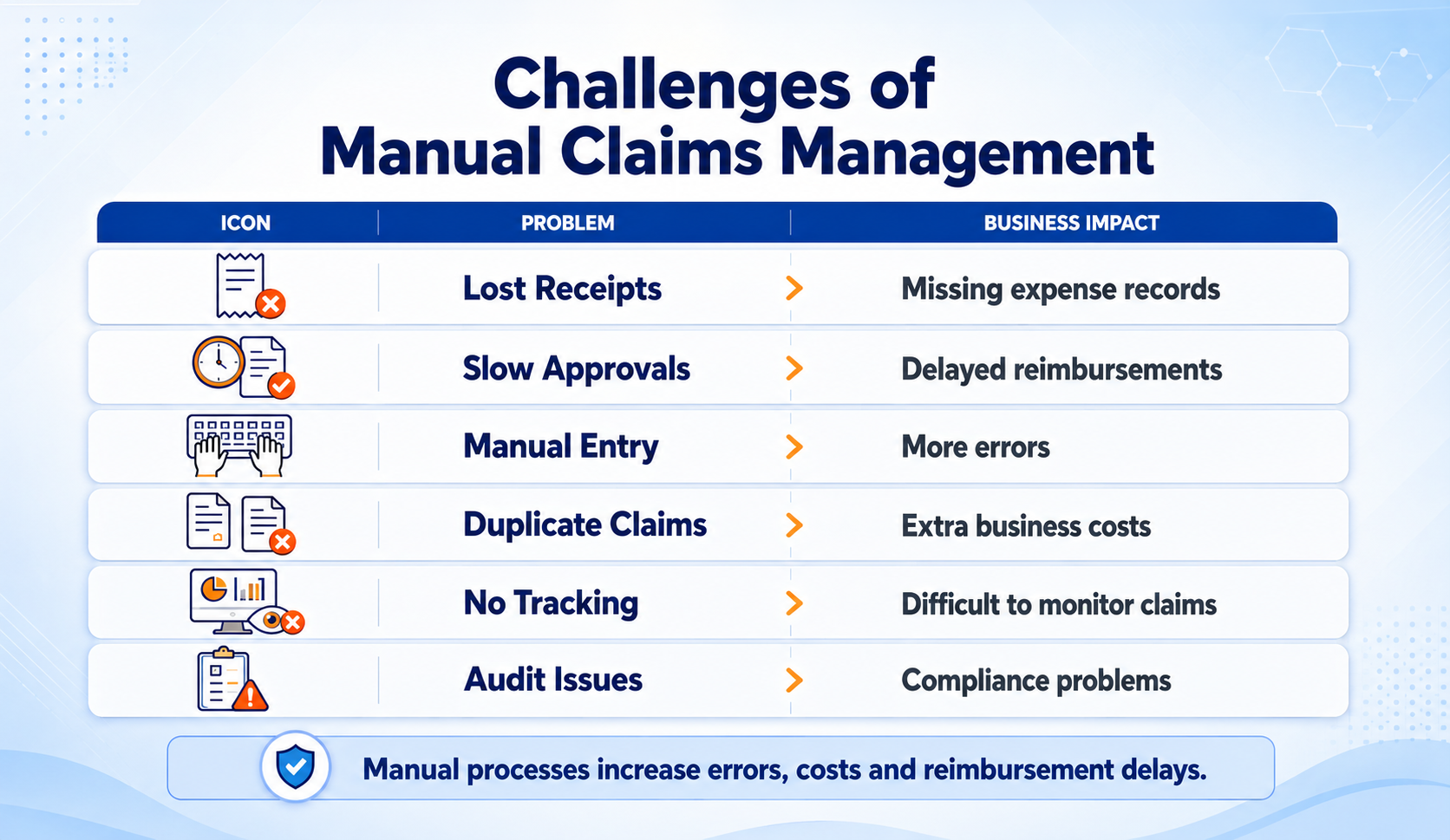
Why Businesses Need Claims Management Software?
According to APQC’s Expense Reimbursement Survey, 78% of organizations are considering or already using AI to improve their expense reimbursement process, with many adopting automation to reduce manual work and improve reporting accuracy. As a result, businesses can expect the following benefits:
Faster Reimbursements
Employees can submit claims online, and the software automatically routes them to the right approver. Therefore, this reduces approval delays and helps reimburse employees faster.
Reduced Manual Work
Employees upload receipts digitally, while OCR technology captures receipt details automatically. As a result, finance teams spend less time entering data manually and can focus on higher-value tasks. Additionally, industry analysts such as Gartner highlight that AI-powered finance automation, including receipt capture, policy validation, and reimbursement workflows, helps improve efficiency, accuracy, and policy compliance across finance operations.
Better Policy Compliance
The software automatically verifies each expense claim against your company’s reimbursement policies. For example, if a claim exceeds approved spending limits or is missing required documents, it is flagged for review, helping businesses maintain consistent policy compliance and reduce approval errors.
Improved Accuracy
Automation minimizes manual errors, duplicate claims, and incorrect reimbursements. As a result, businesses maintain more reliable expense records.
Better Employee Experience
Employees can submit claims, upload receipts, and track reimbursement status from a web portal or mobile app without repeatedly following up with HR or finance. Consequently, the reimbursement process becomes faster and more transparent.
Complete Visibility into Expenses
Real-time dashboards and reports help finance teams monitor department-wise spending, pending approvals, reimbursement trends, and policy violations. Overall, this enables better financial planning and decision-making.
Best Claims Management Software in India: DigiSME , Keka, greyt HR & Zoho Expense
Choosing the right Claims Management Software in India depends on your organization’s size, reimbursement requirements, HR processes, and integration needs. Some businesses prefer an all-in-one HRMS platform that connects claims with payroll and employee data, while others choose dedicated expense management tools for advanced travel and expense tracking. Therefore, below are some of the popular claims management solutions used by businesses in India.
1. DigiSME
DigiSME helps businesses automate employee reimbursements by connecting claims management with payroll, attendance, leave, and employee information. Instead of managing expense requests through spreadsheets and emails, businesses can create a structured digital workflow where employees submit claims, managers approve requests, and finance teams track reimbursements easily.
Suitable For:
- Small and medium-sized businesses
- Organizations looking for HRMS + payroll + claims management
- Growing companies that want simple reimbursement automation
Key Capabilities:
- Digital claim submission
- Receipt upload and verification
- Multi-level approval workflows
- Employee self-service access
- Payroll integration
- Claim tracking and reports
Why Businesses Choose DigiSME:
- Combines HR operations and claims management in one platform
- Reduces manual reimbursement processes
- Improves visibility into employee expenses
- Supports growing business requirements
2. Keka
Similarly, Keka provides HR and payroll solutions with employee reimbursement workflows. The platform helps organizations manage expense requests digitally while maintaining employee information and approval processes in one place. Keka is commonly preferred by companies that want a modern HR experience along with payroll and employee management capabilities.
Suitable For:
- Mid-sized organizations
- Companies already using Keka HRMS
- Businesses focused on improving employee experience
Key Capabilities:
- Online reimbursement requests
- Digital receipt attachments
- Approval automation
- Employee self-service portal
- Payroll connectivity
- Expense records management
Why Businesses Choose Keka:
- Modern employee interface
- Strong HR and payroll ecosystem
- Simplifies reimbursement approvals
3. greytHR
greytHR is an HR and payroll management platform that helps businesses manage employee-related processes, including reimbursement requests and approvals. It is suitable for organizations that want to maintain employee records, payroll operations, and reimbursement workflows within a connected HR system.
Suitable For:
- SMEs managing payroll processes
- Businesses looking for HR automation
- Organizations needing structured employee management
Key Capabilities:
- Online reimbursement requests
- Approval workflows
- Employee self-service
- Payroll integration
- Digital record management
- HR reports
Why Businesses Choose greytHR:
- Established HR and payroll platform
- Helps centralize employee information
- Supports structured HR operations
4. Zoho Expense
Zoho Expense is a dedicated expense management solution designed to automate employee expenses, travel reimbursements, and financial reporting. Unlike HRMS platforms, Zoho Expense focuses primarily on improving expense tracking, receipt management, approvals, and reporting.
Suitable For:
- Businesses with frequent employee travel expenses
- Companies needing dedicated expense automation
- Organizations using Zoho business applications
Key Capabilities:
- OCR receipt scanning
- Automated expense categorization
- Policy-based approvals
- Travel expense tracking
- Expense reporting
- Accounting integrations
Why Businesses Choose Zoho Expense:
- Strong expense automation features
- Useful reporting capabilities
- Helps manage travel-related expenses efficiently
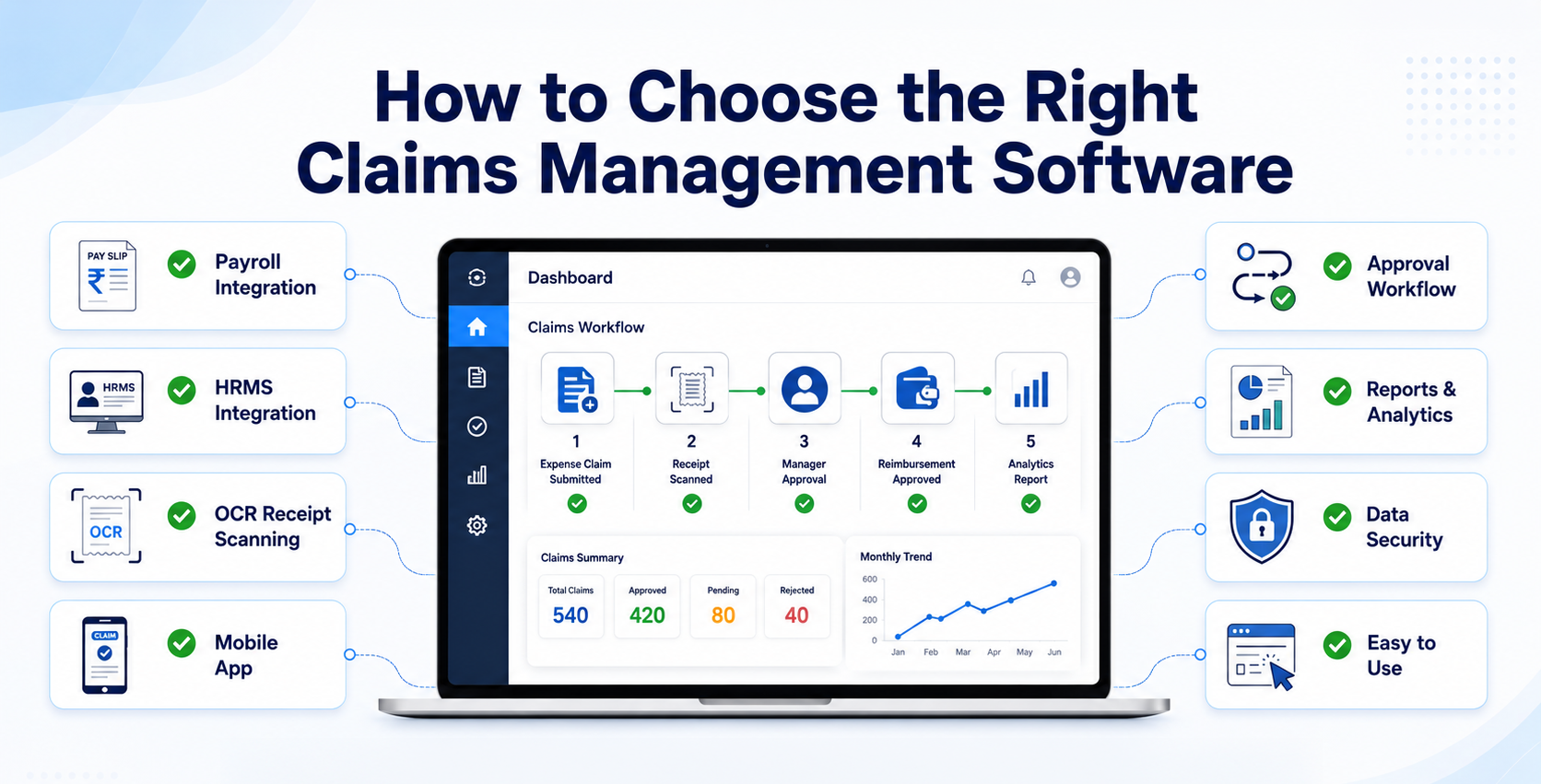
Key Features to Look for in the Best Claims Management Software
The right claims management software should do more than digitize reimbursement requests. It should help businesses automate claim processing, reduce errors, improve approval speed, and provide better control over employee expenses. Therefore, while comparing different solutions, businesses should look for features that simplify the complete claims lifecycle—from submission to approval and reimbursement.
1. OCR Receipt Scanning
Manual receipt entry is one of the biggest challenges in expense processing. OCR receipt scanning allows employees to capture receipts using a mobile app, while the software automatically extracts important details.
As a result, this reduces typing errors, speeds up claim submission, and helps finance teams verify expenses faster. Additionally, Deloitte explains that intelligent OCR helps automate document processing by extracting key information from receipts and invoices, reducing manual effort while improving data accuracy.
2. Automated Claim Submission
A digital claim submission process removes dependency on spreadsheets, paper forms, and email communication.
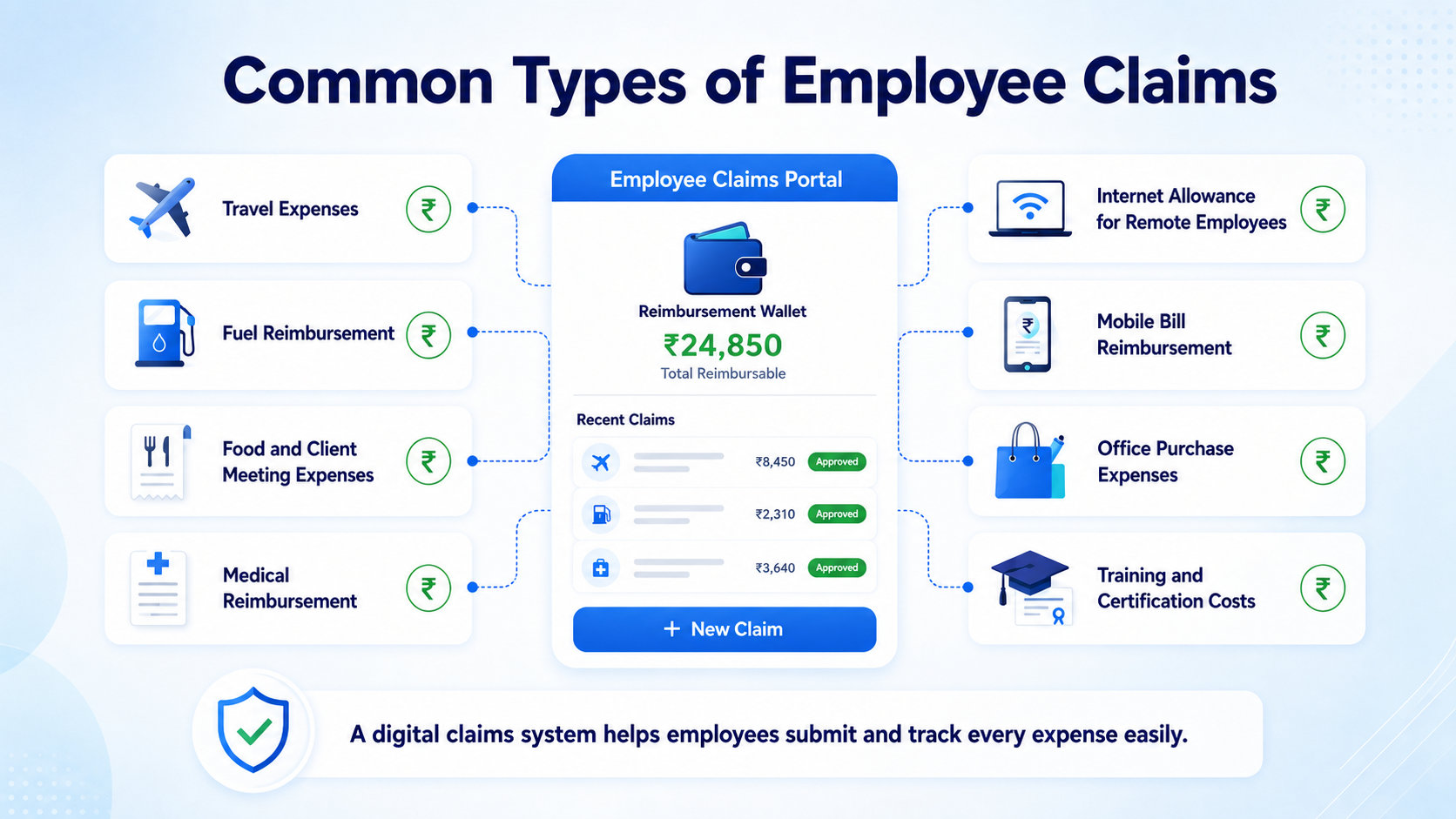
Employees can submit:
- Travel claims
- Fuel expenses
- Food reimbursements
- Medical expenses
- Internet and mobile bills
This creates a faster and more transparent reimbursement process.
3. Multi-Level Approval Workflow
Different organizations follow different approval structures. A flexible approval workflow ensures claims move through the correct hierarchy.
For example:
Employee → Reporting Manager → Department Head → Finance Team
This helps businesses maintain better expense control while avoiding unnecessary approval delays .
4. Payroll and HRMS Integration
Payroll integration is an important feature for businesses managing frequent employee reimbursements. When approved claims automatically connect with payroll, organizations can:
- Reduce manual calculations
- Avoid reimbursement errors
- Process payments faster
- Maintain accurate employee records
An integrated HRMS claims software creates a smoother connection between HR and finance teams.
5. Expense Policy Automation
Every company has different expense rules, limits, and approval requirements. Expense policy automation helps businesses define:
- Spending limits
- Eligible expenses
- Approval requirements
- Department-specific policies
This ensures employees follow company guidelines while reducing manual verification.
6. Mobile App Support
A mobile expense app makes reimbursement management easier for employees working remotely, travelling, or operating across multiple locations.
Employees can:
- Upload receipts instantly
- Submit claims on the go
- Track approval status
- Receive notifications
This improves adoption and reduces pending claims.
7. AI-Based Duplicate Claim Detection
Duplicate claims can increase unnecessary expenses and create compliance issues. Therefore, modern claims processing software uses AI-based checks to identify:
- Repeated receipts
- Similar expense submissions
- Duplicate amounts
- Suspicious claim patterns
Consequently, this helps finance teams improve accuracy and prevent misuse.
8. Reports and Analytics
Finance teams need visibility into business spending. For this reason, advanced reporting features help track:
- Department-wise expenses
- Monthly reimbursement trends
- Pending approvals
- Employee spending patterns
- Policy violations
Ultimately, these insights help businesses make better financial decisions
9. Audit Trail and Security Controls
A complete audit trail records every activity related to a claim, including submission, approval, rejection, and modifications. Along with role-based access controls, it helps businesses maintain:
- Better transparency
- Data security
- Compliance readiness
- Easier audits
Conclusion
Managing employee reimbursements doesn’t have to be complicated. With the right claims management software, your business can eliminate manual paperwork, speed up approvals, reduce reimbursement errors, and give employees a smoother claims experience. Whether you’re a growing startup or an established enterprise, choosing software that integrates with your HRMS and payroll can save valuable time while improving financial accuracy.
When comparing the best claims management software in India, focus on your business needs, workflow flexibility, integration capabilities, and long-term scalability—not just the feature list. Ultimately, a well-chosen solution will help streamline reimbursements, improve financial accuracy, and support your business as it grows.
If you’re looking for an all-in-one platform that combines HRMS, payroll, attendance, and claims management, DigiSME is worth exploring. Schedule a demo today to see how it can simplify employee reimbursements and help your business work more efficiently.
Frequently Asked Questions
What is claims management software?
Claims management software helps employees submit expenses and allows managers and finance teams to review, approve and reimburse them digitally.
Which is the best claims management software in India?
The best option depends on your needs. DigiSME suits integrated HRMS and payroll, Keka works well for HR-focused businesses, and Zoho Expense is strong for travel and expense automation.
Can claims software integrate with payroll?
Yes. Payroll integration allows approved reimbursements to move directly into salary processing, reducing manual work and payment errors.
Is claims management software suitable for SMEs?
Yes. SMEs can use it to reduce paperwork, speed up approvals, track expenses and improve reimbursement accuracy.
