Managing HR today is no longer limited to payroll and attendance, it’s about data, compliance, and real-time decision-making. India’s HR tech market has already reached $1.3 billion in 2025 and is expected to grow to $4.6 billion by 2034, driven by automation and cloud adoption.
With 64% of HR software investments focused on workforce digitization, businesses, especially those with 100+ employees, are moving away from manual processes toward integrated HRMS platforms. Modern HR software brings everything into one system, helping companies streamline operations, reduce errors, and scale efficiently.
In this blog, we’ll explore:
- What to Look for in the Best HR Software in India (2026)
- Top HR Software in India (2026): HRMS Comparison for Growing Companies
- How to Choose HR Software Based on Company Size and Operating Model
- Common Mistakes When Choosing HR Software in India
What to Look for in the Best HR Software in India (2026)
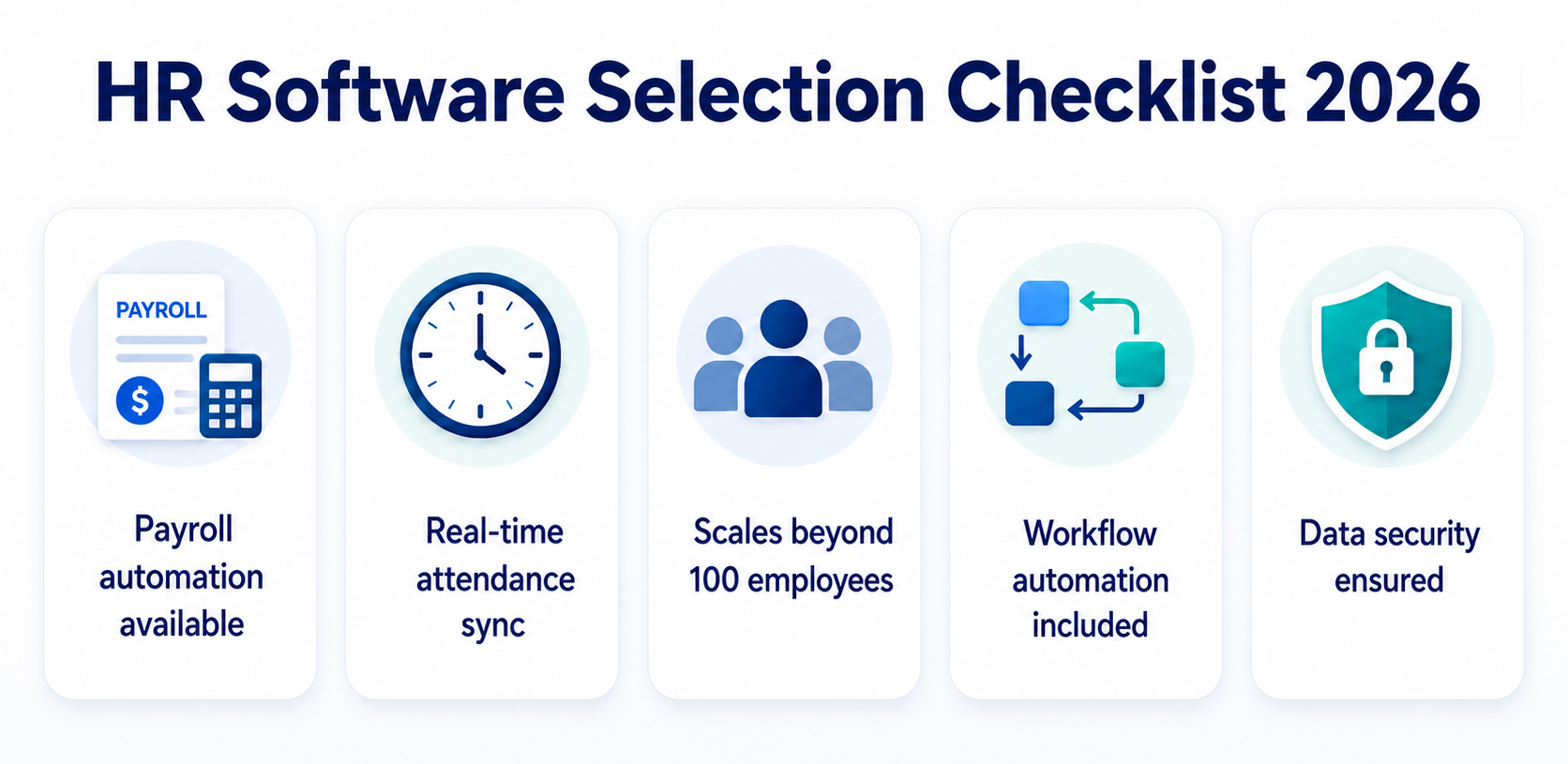
Choosing the right best HR software in India is not about features. Instead, it is about how well the system handles real operations when your company crosses 100 employees. In most cases, most HR software challenges in India and HRMS issues after 100 employees come from gaps between payroll, attendance, and compliance. Therefore, if these are not tightly connected, errors become unavoidable.
Payroll Accuracy & Compliance in HRMS
Payroll accuracy is critical because errors in PF, ESI, TDS, or salary calculations directly impact compliance, employee trust, and financial stability. Moreover, payroll in India is operationally heavy. It is not just about salary calculation. In fact, it involves PF, ESI, professional tax, TDS, and monthly filings.
A common issue seen in growing companies is incorrect salary processing due to outdated attendance data. As a result, this leads to reprocessing payroll, delays, and employee dissatisfaction. In addition, compliance errors add another layer of risk, especially with strict PF and TDS timelines.
The best HR software features must include a payroll engine that is built for Indian compliance. Ideally, a strong payroll software India solution should automatically calculate deductions, stay updated with statutory changes, and sync directly with attendance data to avoid manual intervention.
Real-Time Attendance Tracking for Payroll Accuracy
Attendance tracking is essential because payroll depends directly on real-time employee attendance, leave, and shift data. Simply put, attendance is the foundation of payroll. If attendance is not accurate, payroll cannot be accurate. However, many companies still use disconnected systems where attendance is tracked in one tool and payroll is processed in another. Consequently, this creates gaps.
For example, an employee may be marked present in the system but has applied for leave separately. In such cases, if these systems do not sync, payroll gets processed incorrectly. Therefore, a reliable HRMS for Indian companies must offer real-time attendance tracking where every update, whether it is leave, shift change, or overtime, reflects instantly in payroll. As a result, this reduces dependency on manual corrections and eliminates repetitive errors.
Scalability for 100+ Employees in HR Software India
HRMS scalability means the software can handle increasing employees, payroll volume, multi-location operations, and complex workflows without performance issues. Initially, most tools work well for small teams. However, the challenge starts when operations grow. At 100+ employees, HR teams deal with multiple departments, locations, and policies. As a result, systems that are not built for scale start slowing down. Reports take longer, bulk actions fail, and manual work increases.
A scalable HRMS for Indian companies should handle large datasets without performance issues. Additionally, it should support multi-location attendance, bulk payroll processing, and structured workflows without breaking the system.
Automation & Workflow Efficiency in HRMS Platforms
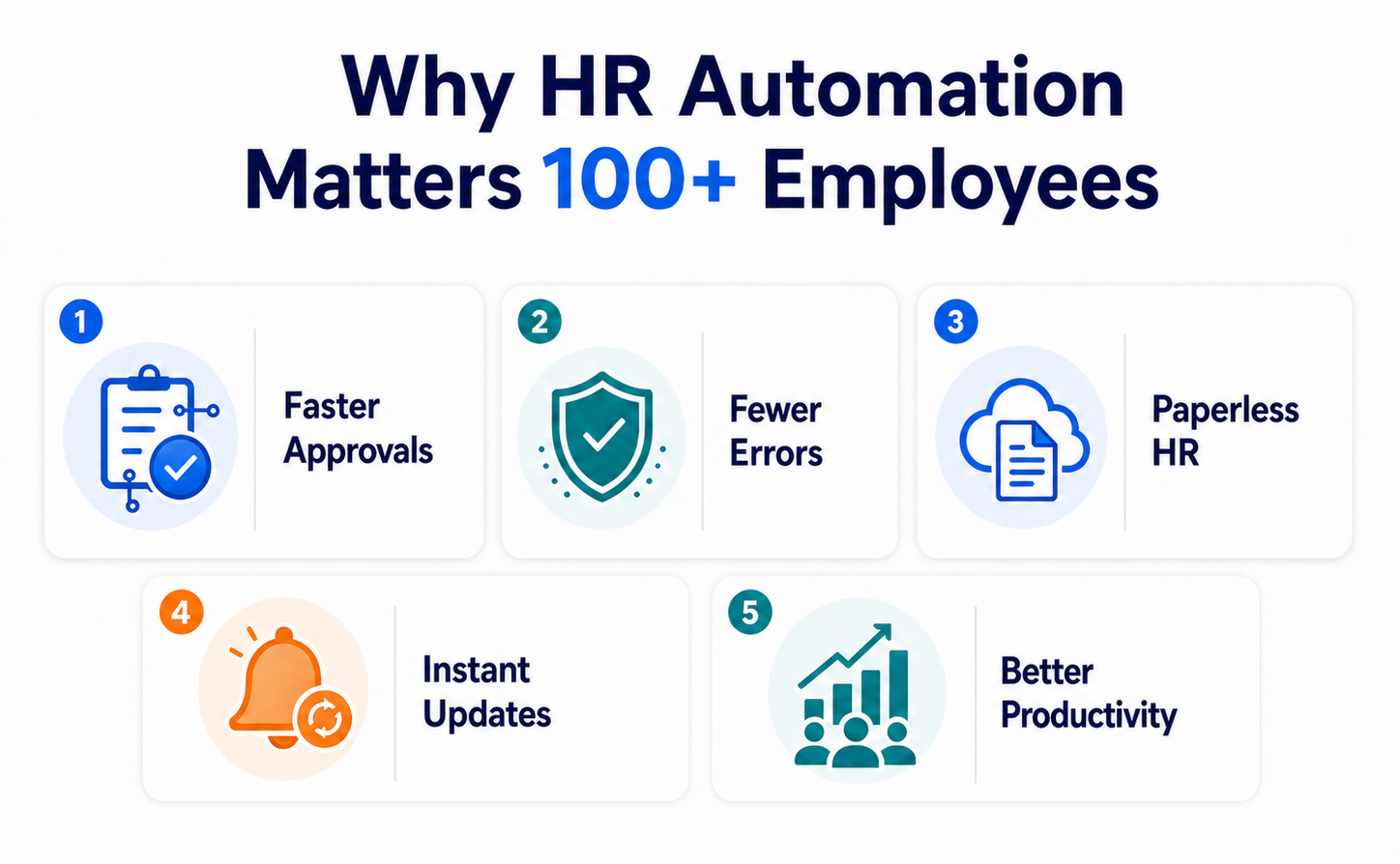
HR automation reduces manual work by automating approvals, payroll processing, attendance updates, and employee lifecycle workflows. In fact, manual processes are one of the biggest reasons behind HR software challenges in India.
In many companies, leave approvals happen over messages, salary revisions are handled in Excel, and payslips are shared manually. Because of this, these processes are time-consuming and prone to errors. Therefore, the best HR software features should include automation where approvals, notifications, and updates happen within the system. This way, it improves efficiency and ensures consistency across operations.
Data Security & Reliability in HR Software Systems
HR systems store sensitive employee data, including salary, bank details, and identity information. Therefore, any breach or data loss can have serious consequences. A reliable HRMS for Indian companies must provide secure cloud hosting, role-based access control, and proper data logs. As a result, this ensures that only authorized users can access specific data, and every action is tracked. For companies with 100+ employees, data reliability is not optional. Instead, it is a critical requirement for smooth operations and compliance readiness.
Top HR Software in India (2026): HRMS Comparison for Growing Companies
The best HR software in India depends on company size, but for 100+ employees, integrated HRMS platforms with payroll, attendance, and compliance automation perform best. Choosing the top HR software in India (2026) becomes difficult when every platform looks similar on the surface. However, real differences become visible once companies cross 100+ employees, where payroll accuracy, compliance, and integration start becoming critical.
According to industry insights, most HRMS software in India now focuses on combining payroll, attendance, and compliance into a single system to reduce manual work and errors. This is where many platforms fail, leading to common HR software challenges in India, especially in scaling companies. Below is a simplified HRMS comparison in India (2026) based on real operational performance, scalability, and payroll efficiency.
DigiSME HRMS – Best HR Software for 100+ Employees in India
DigiSME HRMS is designed for companies that have outgrown basic HR tools and need a single platform to manage complete HR operations. At this stage, most payroll errors happen due to mismatched attendance, delayed leave updates, or disconnected systems. DigiSME solves this by offering a fully integrated system where payroll, attendance, leave, and claims work in real-time sync. It also extends beyond HR with CRM support, making it useful for growing businesses.
It offers:
- Real-time sync between payroll, attendance, and leave
- GPS and facial-recognition-based attendance
- Mobile payslip access for employees
- Field staff tracking (add-on)
- Transparent pricing at ₹35 per employee (minimum 100 employees)
- Multilingual support (Tamil, English, Hindi) and Azure-based hosting
This ensures:
- No manual payroll corrections
- Accurate salary processing
- Reduced dependency on Excel
Best suited for growing companies that need practical, scalable, and connected HR operations.
Zoho People is a widely used HR software in India for small businesses and mid-sized teams.
It is simple to use and handles core HR functions like:
- Employee records
- Attendance tracking
- Leave management
Zoho also provides free plans and integrates easily with Zoho Payroll, Books, and Expense. However, payroll is often managed as a separate module, which can create integration gaps as companies scale.
Best suited for smaller teams looking for flexible and ecosystem-based HR solutions.
Keka HR is a strong mid-market HRMS in India, known for its clean interface and structured HR workflows.
It offers:
- Payroll, attendance, and HR management in one system
- Employee self-service with payslips and Form 16
- Compliance support and integrations
- Analytics and reporting
Keka is widely used by growing companies that want better employee experience and organized HR processes.
Best suited for mid-sized companies needing balanced HR depth and usability.
Darwinbox is a powerful enterprise HRMS software in India, designed for large organizations with complex HR operations.
It includes:
- Advanced workflows and automation
- HR analytics and reporting dashboards
- High customization for enterprise needs
However, implementation takes time and requires strong internal HR setup. Best suited for large enterprises and fast-scaling organizations.
GreytHR is a well-established payroll-focused HR software in India, known for strong compliance handling and affordability.
It supports:
- Payroll processing with PF, ESI, and TDS
- Attendance and leave management
- Employee self-service (ESS)
It is simple, reliable, and cost-effective, but more focused on payroll than complete HR operations.
Best suited for companies prioritizing payroll accuracy and compliance.
| Software | Best For |
| DigiSME | Operations-focused growing companies (100+ employees) |
| Zoho People | Small to mid-sized teams using Zoho ecosystem |
| Keka HR | Mid-sized companies focusing on employee experience |
| Darwinbox | Large enterprises with complex HR workflows |
| greytHR | Payroll and compliance-focused companies |
How to Choose HR Software Based on Company Size and Operating Model
Choosing the right HR software is not just about features—it’s about how well the platform fits your company’s size, structure, and daily operations. The wrong choice leads to disconnected workflows, payroll errors, and low adoption. The right one improves efficiency, compliance, and decision-making from day one.
For Startups & Small Businesses (0–50 Employees)
If your company is already using tools from Zoho for finance or CRM, then extending into Zoho People with Zoho Payroll is usually the most practical move.
Why this works:
- Native integration with existing Zoho apps
- Free tiers and transparent pricing
- Simple setup for small HR teams
- Works best for businesses with limited HR complexity
This model suits companies that want a plug-and-play HR system without heavy customization.
For Payroll-Focused SMBs (50–150 Employees)
If your priority is accurate payroll, statutory compliance, and employee self-service (ESS), then greytHR is a strong benchmark.
Why this works:
- Proven payroll engine with compliance focus
- Stable ESS portal for employees
- Cost-effective for growing teams
- Minimal learning curve for HR teams
This model fits companies where HR operations are still payroll-centric, not deeply strategic.
For Mid-Sized Companies (150–500 Employees)
As companies scale, HR needs go beyond payroll into performance, hiring, and engagement. This is where Keka becomes relevant.
Why this works:
- Strong performance management features
- Better UI/UX for employee engagement
- Suitable for structured HR processes
- Covers a broader HR lifecycle
This model works best for organizations moving toward a more process-driven HR function.
For Growing Companies (100+ Employees with Multi-Operational Needs)
If your company is scaling and needs a balanced, operations-first HR system, DigiSME stands out as a strong fit.
Why DigiSME works in real-world operations:
- Transparent pricing without hidden costs
- Support-led implementation (not just self-setup)
- Native sync between payroll, attendance, and leave
- Mobile-based attendance with control features
- Built for Indian compliance and multi-location teams
- Extended ecosystem, including CRM for business growth
Unlike tools that specialize in just one area, DigiSME focuses on operational clarity—where payroll, attendance, approvals, and workflows work together without gaps.
Common Mistakes When Choosing HR Software in India
HR software implementations in India often fail not because the tool is bad, but because of wrong decisions during selection. In fact, Many companies choose HR software based on immediate needs without thinking about future scale.
For example, some of the most common mistakes include:
- Choosing software based only on price
- Ignoring integration between payroll, attendance, and leave
- Not considering scalability beyond 100 employees
- Using multiple disconnected tools for HR operations
As a result, these decisions may work in the early stages, but as the company grows, they start creating operational challenges.
Why DigiSME HRMS Is the Right Choice for Growing Indian Businesses?
For companies in the 100 to 500 employee range, HR software is no longer just a management tool, it becomes an operational backbone. At this stage, the focus shifts from feature availability to accuracy, automation, and system reliability.
DigiSME HRMS ensures that payroll, attendance, and compliance work together in a single ecosystem. As a result, this reduces operational errors, improves processing speed, and eliminates the need for multiple disconnected tools. Therefore, for growing Indian businesses, this operational alignment is what makes DigiSME a practical HRMS choice for 2026.
Final Verdict
Once a company crosses 100+ employees, HR software becomes less about basic administration and more about ensuring payroll accuracy, compliance stability, and smooth day-to-day operations. At this point, most challenges come from disconnected systems that force HR teams into constant manual corrections and error handling.
The right HRMS is the one that keeps payroll, attendance, and compliance tightly integrated so that data flows automatically without friction. In this context, this is where DigiSME stands out for growing Indian companies. It is built specifically for 100+ employee organizations that need accurate payroll processing, real-time attendance sync, and simplified compliance without depending on multiple tools or manual workarounds.
Overall, for companies scaling in India, DigiSME offers a more practical approach to HR management by focusing on operational clarity, reduced errors, and system-level efficiency, making it a strong HRMS choice for 2026 and beyond.
Frequently Asked Questions
What is the best HR software in India for companies with 100+ employees?
The best HR software is one that integrates payroll, attendance, leave, and compliance into a single system. Popular options include DigiSME, Keka, Darwinbox, Zoho People, and greytHR depending on company size.
What are the key features of the best HR software in India (2026)?
The most important features of modern HR software include: Real- time attendance tracking Automated payroll processing Compliance management (PF, ESI, TDS) Employee self- service portal Workflow automation (leave, approvals , onboarding) Multi-location scalability Data security and role-based access These features help companies reduce manual HR work and improve operational efficiency.
Why do HR software implementations fail in India?
HR software implementations in India often fail due to: Choosing software only based on price Lack of integration between payroll and attendance Poor scalability planning beyond 100 employees Inadequate training and onboarding Manual dependency instead of automation
Is HR software secure?
Yes, modern HR software is secure when it includes encryption, role-based access control, audit logs, and cloud security infrastructure.
