As organizations continue their digital transformation journey, HR technology has become a strategic investment rather than just an operational tool. Deloitte’s Global Human Capital Trends report found that 62% of business and HR leaders consider orchestrating work and workforce technologies critical to organizational success, highlighting the growing importance of modern HR systems.This shift is even more visible for companies with 100+ employees, where payroll complexity, statutory compliance, and multi-team coordination make manual HR processes difficult to manage. As a result, choosing HR software has become a critical business decision rather than just a tool upgrade.
Platforms like Zoho People, Keka HRMS, and DigiSME offer almost similar core features such as payroll, attendance, and employee management. However, the real difference lies in usability, scalability, and how each system fits different SME workflows and growth stages. This blog provides a clear Zoho vs Keka vs DigiSME comparison. It helps Indian SMEs identify the best HR software for 2026. The choice depends on company size and workflow needs.
Detailed Software Breakdown: Zoho vs Keka vs DigiSME
Core Philosophy Behind Each HRMS
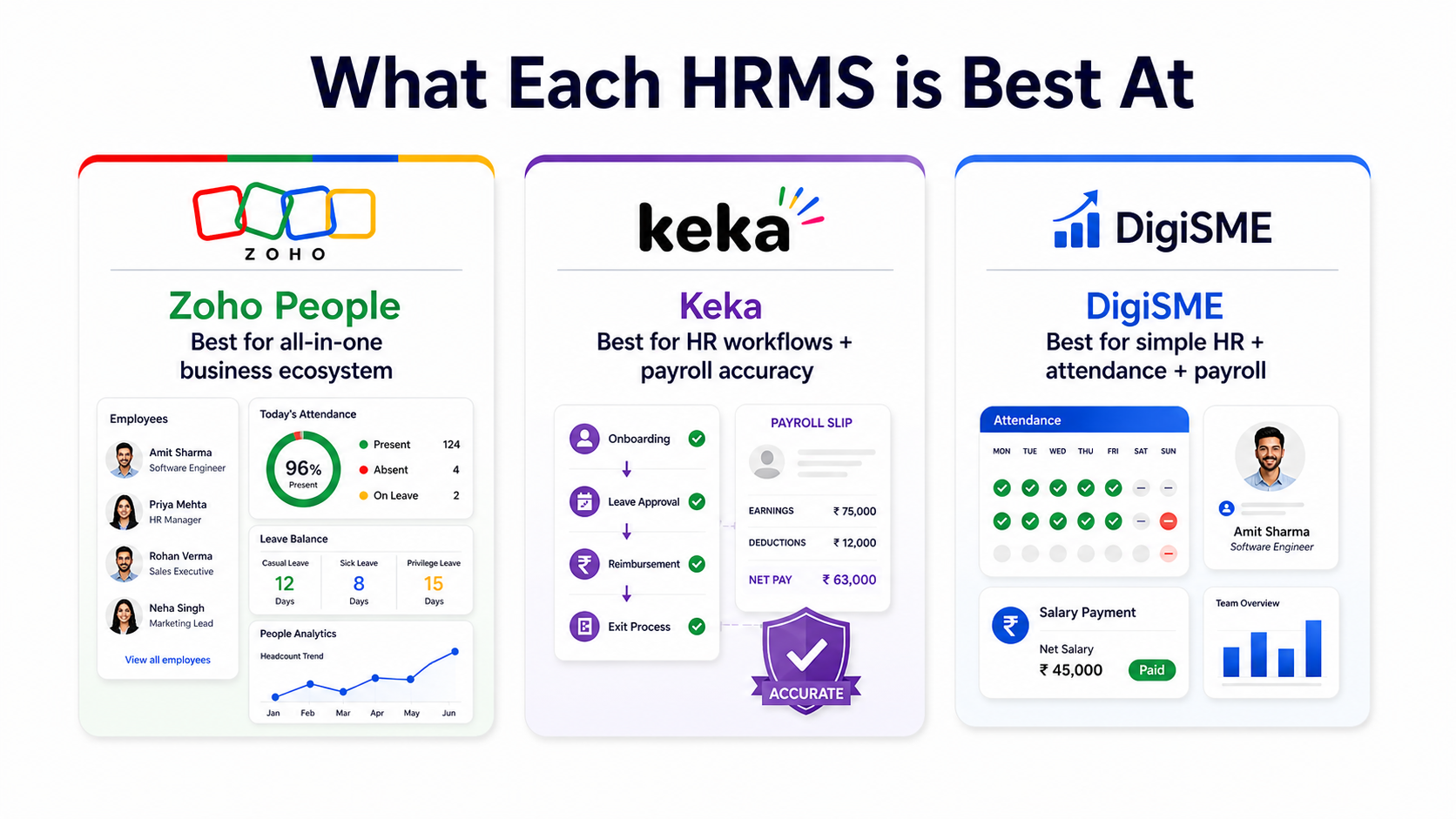
Zoho, Keka, and DigiSME all solve the same core problem of managing HR operations and payroll, but they follow different philosophies. To begin with, Zoho follows a modular ecosystem approach where HR connects with finance and business tools. On the other hand, Keka positions itself as a mid-market HRMS with strong payroll execution and employee self-service workflows. Meanwhile, DigiSME focuses more on operational clarity for Indian SMEs, especially companies with 100+ employees, where payroll accuracy, attendance control, and simple implementation matter more than layered features.
In simple terms, Zoho works best when you want an ecosystem-driven HRMS, whereas Keka works well when you want deeper HR workflows and payroll strength. Businesses often prefer DigiSME when they want a straightforward, India-focused HR system that reduces operational complexity instead of adding layers. instead of adding layers.
As a result, this is why Zoho vs Keka vs DigiSME is becoming one of the most searched HR software comparisons in India today, especially among growing SMEs evaluating HRMS for SMEs and best HR software India 2026 options.
Pricing and commercial model in HR software in India
Pricing is one of the first filters for any SME evaluating HR software in India; the three platforms differ significantly.
Firstly, DigiSME follows a clear per-employee pricing model. It starts at ₹35 per employee per month, with a minimum requirement of 100 employees. As a result, it becomes a predictable option for companies scaling beyond the startup stage. Additionally, it also offers add-ons like field staff tracking, which is useful for sales-heavy or distributed teams. Overall, this pricing structure helps companies maintain clarity and directly map costs as they grow.
Next, Zoho follows a modular pricing approach. HR and payroll are separate components. Zoho People offers tiered plans, starting with free usage for small teams. Zoho Payroll also uses structured pricing based on employee count and plan level. Because of this, Zoho becomes flexible. However, the total cost depends on how many modules a company activates within the ecosystem. This is an important factor when comparing Zoho People vs Keka.
Finally, Keka is positioned at a higher entry price than most SMB tools. Its pricing usually starts with a fixed monthly structure for up to 100 employees. It then increases based on usage and additional modules. Although it is more expensive than entry-level tools, it reflects its position as a mid-market HRMS. It offers stronger payroll capabilities and better employee experience features.
In conclusion, when evaluating payroll software comparison in India, the key difference is not just cost but predictability. DigiSME offers simpler cost clarity. Zoho provides modular flexibility. Meanwhile, Keka sits in between with a more structured mid-market pricing model.
Feature depth and workflow fit in HRMS for SMEs
Feature lists across modern HR platforms often look similar; workflow design is where real differences appear in HRMS for SMEs.
- DigiSME focuses heavily on connected workflows where attendance, leave, claims, and payroll are tightly linked. As a result, this reduces manual intervention in payroll processing, especially for companies with 100+ employees. In addition, it also includes attendance tracking through GPS and biometric integration, along with basic HR modules. Overall, the emphasis is on reducing operational friction rather than overwhelming users with configuration-heavy systems.
- Zoho People takes a broader ecosystem approach. It covers onboarding, attendance, performance management, and HR analytics, and becomes more powerful when connected with Zoho Payroll and tools. However, because of its modular design, companies often need time to configure workflows properly. Therefore, it is flexible, but it requires planning to unlock full value, especially in Zoho People vs Keka comparisons.
- Keka is known for balancing payroll strength with structured HR workflows. For instance, it supports ESS (employee self-service), attendance-payroll synchronization, performance tracking, and compliance workflows across multiple locations. Its payroll engine is one of its strongest components, handling salary revisions, off-cycle payments, and statutory compliance with more depth compared to many SMB tools. Because of this, it makes it a strong choice when payroll accuracy and structured HR processes are equally important.
Integrations, support, and implementation experience
Integration and support often decide whether HR software succeeds or fails inside an SME environment.
DigiSME emphasizes native workflow integration, where attendance, leave, payroll, and claims stay connected within the system. Additionally, it supports integrations with commonly used communication tools like Microsoft Teams, Gmail, and Zoom. Furthermore, the platform typically includes guided implementation, and the onboarding team supports companies scaling beyond 100 employees, making it easier for teams without dedicated HR tech expertise.
Zoho is the strongest in ecosystem integration. Specifically, it connects naturally with other Zoho applications such as Zoho Books, Zoho Expense, and Zoho CRM, along with third-party APIs. Therefore, this makes it ideal for companies already using Zoho products. However, its implementation is smoother in such environments, but for standalone HR adoption, setup complexity can be higher compared to simpler HRMS tools.
Keka offers strong API-driven integrations and supports third-party systems and payroll tools. In addition, it is more IT-friendly and works well for companies that already have structured internal systems. Generally, support is responsive, and its onboarding process is designed for mid-sized businesses that need more structured deployment and training.
HR Software Based on Business Size and Needs
Choosing the right HR software is less about features and more about company stage. In fact, in the context of HR software in India, especially for HRMS for SMEs with 100+ employees, each platform fits a different growth level and operational complexity.
- For companies with 50–100 employees, the focus is usually on affordability and basic automation. At this stage, Zoho People works well because it offers flexible modules and low entry cost, especially for teams already using Zoho tools. Similarly, DigiSME also fits here when companies want a simple, structured HR system without heavy setup or technical dependency.
- For businesses in the 100–300 employee range, HR complexity increases due to payroll cycles, compliance load, and multi-team coordination. This is where Keka HRMS becomes a strong choice because of its structured payroll system, employee self-service features, and better workflow control. In addition, DigiSME also performs well, especially for companies that want operational simplicity with strong attendance and payroll linkage. Meanwhile, Zoho continues to be relevant, but only when the organization is comfortable managing a modular system.
- For companies with 300–500+ employees, scalability and process depth become critical. Therefore, companies in this segment more commonly use Keka HRMS and Darwinbox because they offer stronger HR workflows and better scalability. However, Zoho can still scale, but it often requires deeper ecosystem dependency. On the other hand, companies typically choose DigiSME when they prefer a stable, operations-first system over highly complex enterprise workflows.
| Criteria | Zoho People | Keka HRMS | DigiSME |
| Payroll strength | Medium, depends on Zoho Payroll integration | Strong payroll engine with detailed processing | Strong focus on automated payroll linked with attendance |
| Compliance handling | Good, but modular setup required | Strong statutory compliance and multi-location support | Built for India compliance with simplified execution |
| Ease of use | Moderate, needs configuration in ecosystem | Easy for structured HR teams | Very simple and operationally focused for SMEs |
| Pricing suitability | Flexible but depends on modules used | Mid to premium pricing | Transparent per-employee pricing for 100+ employees |
| Scalability | Good within Zoho ecosystem | High scalability for mid-market growth | Designed for growing SMEs (100–500+ employees) |
Decision Guide: How to Choose Between Zoho vs Keka vs DigiSME
Choosing between Zoho vs Keka vs DigiSME depends less on features and more on how your HR operations function on a daily basis.
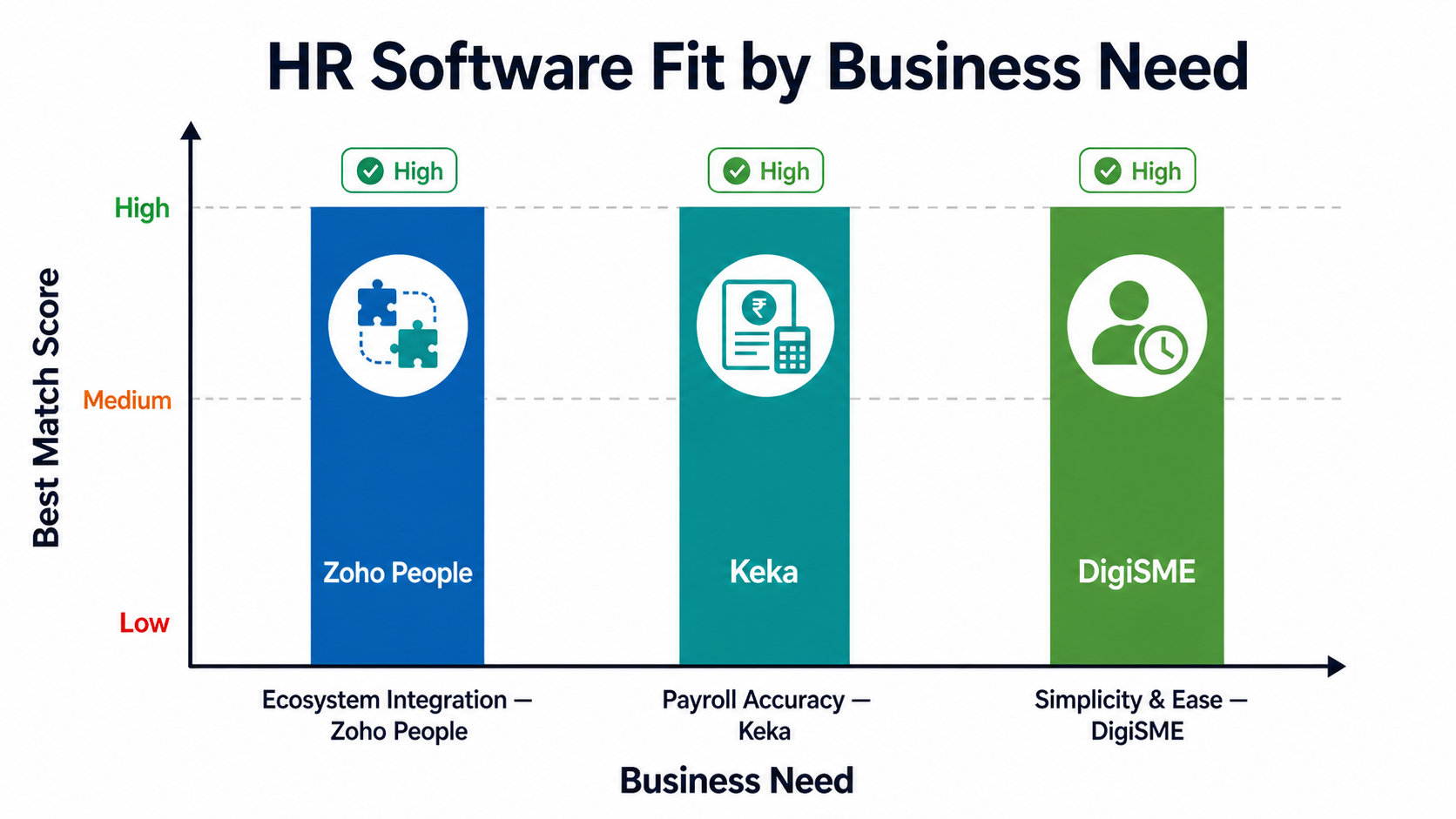
- If your company already uses multiple business tools and wants a connected ecosystem where HR integrates with finance, CRM, and operations, Zoho People is a strong fit. It works best for organizations that manage modular systems and customize workflows across departments.
- If your priority is structured HR operations with strong payroll accuracy, compliance control, and employee self-service features, Keka HRMS suits your needs better. It works well for companies where HR teams follow formal processes and need tighter control across teams, locations, and payroll cycles.
- If your focus is simplicity, faster adoption, and smooth HR execution for 100+ employees without operational complexity, DigiSME fits best. It is designed for SMEs that want payroll, attendance, and compliance to work together in a straightforward system without heavy configuration or dependency on multiple modules.
For context, companies with very basic needs often also evaluate tools like greytHR, while large enterprises typically move toward platforms like Darwinbox.
Common Mistakes SMEs Make While Choosing HR Software
Most SMEs comparing HR software in India focus only on features or pricing. However, the real issues often start after implementation. In reality, many companies using HRMS for SMEs like Zoho, Keka, or DigiSME struggle not because of the tool, but because of the selection approach.
One of the biggest mistakes is choosing HR software based only on features shown in demos. For example, many platforms look similar during sales discussions. However, they behave very differently when handling real payroll, attendance, and compliance at scale.
In addition, another common issue is ignoring actual business size needs. A system that works for 30–50 employees may not perform smoothly when the company crosses 100+ employees. This is especially true for payroll and approval workflows.
SMEs also often underestimate compliance requirements in India. For instance, PF, ESI, professional tax, and state-specific rules can quickly become complex if the system is not built for Indian payroll structures. Therefore, this is why payroll software India decisions should always include compliance depth, and not just UI or dashboards. Additionally, another mistake is overbuying. Many companies invest in advanced modules like performance management or AI analytics before stabilizing basic processes like attendance and payroll. As a result, this leads to unused features and low adoption.
Finally, poor internal adoption planning is a silent failure point. Even the best system in a Zoho vs Keka vs DigiSME comparison can fail. This happens if managers and employees do not use it daily for approvals, attendance, and payroll-related actions. Choosing the right HR software is not about picking the most popular tool. Instead, it is about selecting a solution that matches your current HR maturity, team size, and operational complexity.
Final Verdict: Zoho vs Keka vs DigiSME for Indian SMEs
There is no single winner in Zoho vs Keka vs DigiSME. The right choice depends on how your HR operations are set up today and how fast your company is growing. Zoho People works best if you want a connected system with other Zoho tools. It is also ideal if you prefer a modular setup for HR, payroll, and business operations.
Keka HRMS is better suited for growing companies. It works well for businesses that need strong payroll control, structured HR workflows, and better employee self-service. Similarly, DigiSME is ideal for SMEs with 100+ employees. It suits companies that want a simple, India-focused system where payroll, attendance, and compliance work together without complexity.
In simple terms, Zoho fits ecosystem-driven businesses. Keka fits structured HR teams. DigiSME fits companies that want clarity and easy day-to-day HR management at scale.
Frequently Asked Questions
Which is the best HR software for Indian SMEs in 2026?
There is no single best option. Zoho People is best for ecosystem-based HR management, Keka HRMS for structured payroll and HR workflows, and DigiSME for simple, India-focused HR operations for growing SMEs.
Who should use DigiSME HR software?
DigiSME is ideal for Indian SMEs with 100+ employees who want a simple HR system for payroll, attendance, and compliance without complex setup or heavy configuration.
What is the main difference between Zoho, Keka, and DigiSME?
The key difference is approach: Zoho → Modular HR ecosystem Keka → Structured HR + strong payroll system DigiSME → Simple, operations-focused HR for SMEs
Which HR software is the easiest to implement?
DigiSME is the easiest to implement due to its simple workflow design. Keka requires moderate setup, while Zoho may need more configuration depending on modules used.
