

Table of Content
- 1.Why Is Income Tax Filing Important?
- 2.Who Needs to File an ITR in India?
- 3.What Is the ITR Filing Due Date?
- 4.What Happens If You Miss the ITR Filing Deadline?
- 5.What Documents Are Required for ITR Filing?
- 6.What Are Common ITR Filing Mistakes to Avoid?
- 7.What Are the Benefits of Filing ITR on Time?
- 8.Income Tax Filing Frequently Asked Questions
As per Indian law, filing your income tax return is essential to handling your personal finances (ITR). Whether you are an employee, freelancer, or business owner, you should know how to submit an Indian tax return online because it guarantees that you can reduce fines and fully utilize deductions and refunds.
This blog will provide you with all the information you need to file your income taxes in India, including eligibility, necessary documents, procedures, common errors, and important dates.
Why Is Income Tax Filing Important?
Filing your income tax return is mandated by law and shows that you are financially responsible in India. Submission of an ITR on time can:
- Help you submit a tax return claim.
- Prove your income while applying for a loan or a visa.
- Permit losses to be carried forward.
- Avoid fines and legal issues.
Even if your income is below the taxable threshold, there may be long-term advantages to voluntarily filing an ITR.
Who Needs to File an ITR in India?
Indian tax regulations require you to submit your ITR if:
- Your income is above the applicable exemption limit.
- You’d like to get your money back.
- You have received revenue from freelancing, rent, or capital gains.
- You own unlisted stock or serve as a director of a business.
- You have assets or income overseas.
It is advisable to file returns to keep a record with the Income Tax Department, even if your income is below the limit.
What Is the ITR Filing Due Date?
The deadline to file your Income Tax Return (ITR) for the financial year 2025–26 (Assessment Year 2026–27) depends on your taxpayer category.
For individuals and other taxpayers who do not require an audit, the regular due date was 31st July 2026. For ITR-4, the Income Tax Department has specified 31st August 2026 as the due date.
If you missed the applicable deadline, you may still be able to file a belated return, subject to the applicable late filing fee and other conditions. For AY 2026–27, the belated return can be filed up to 31st December 2026, or before completion of the assessment, whichever is earlier.
But don’t wait till the last minute; missing this deadline could cost you.
Income Tax Filing Due Dates
| Category of Taxpayer | Due Date |
|---|---|
| Individual / HUF / AOP / BOI – where books of accounts are not required to be audited | 31st July 2026 |
| ITR-4 taxpayers | 31st August 2026 |
| Businesses requiring audit | 31st October 2026 |
| Businesses requiring transfer pricing reports | 30th November 2026 |
| Belated return | 31st December 2026 |
| Revised return | 31st December 2026 |
| Updated return (ITR-U) | Subject to the applicable time limit and conditions |
What Happens If You Miss the ITR Filing Deadline?
If you don’t file your ITR by the applicable due date, you may still be able to file a belated return, subject to the rules and time limits that apply to your return.
Here’s what you might face:
1. Interest on Late Payment (Section 234A)
You’ll be charged 1% interest per month (or part of a month) on any unpaid tax amount, calculated from the due date until the date of filing.
2. Late Filing Fee (Section 234F)
- ₹5,000, if your total income is above ₹5 lakh
- ₹1,000, if your total income is ₹5 lakh or less
3. Loss of Tax Benefits
Filing late can also result in:
- Losing the chance to carry forward certain losses
- Delayed refunds, if any, are due
What Documents Are Required for ITR Filing?
Before initiating the ITR filing process, ensure that you have the following documentation available:
- PAN Card
- Aadhaar Card
- Form 16 (for salaried individuals) from the employer
- Information about a bank account
- Interest certificates (found in FDs and savings accounts)
- Investment evidence (e.g., LIC, ELSS, PPF)
- Returns on capital gains
- Statement of home loan (if qualifying for a Section 24 deduction)
Need help managing salary slips, Form 16, or automated payroll compliance? Explore our Payroll Management Solutions for businesses of all sizes.
What Are Common ITR Filing Mistakes to Avoid?
Avoiding errors while filing ensures faster processing and prevents unnecessary scrutiny. Common mistakes include:
- Choosing the wrong ITR form
- Not reporting interest income
- Missing out on deductions
- Using incorrect bank account details
- Forgetting to e-verify, which invalidates the submission
Always cross-check Form 16, bank statements, and Annual Information Statement (AIS) for accuracy.
What Are the Benefits of Filing ITR on Time?
Filing your return before the deadline has several advantages:
- Avoids penalties and interest
- Allows carry forward of losses
- Enables quicker refund processing
- Required for loan or visa applications
- Maintains a strong financial record
Early filers also have more time to rectify any issues in their return or portal profile.
Conclusion
Income tax filing becomes easier when you have the right documents, choose the appropriate ITR form and check the applicable filing deadline. Before submitting your return, review your income, deductions, bank details and AIS information to avoid common mistakes.
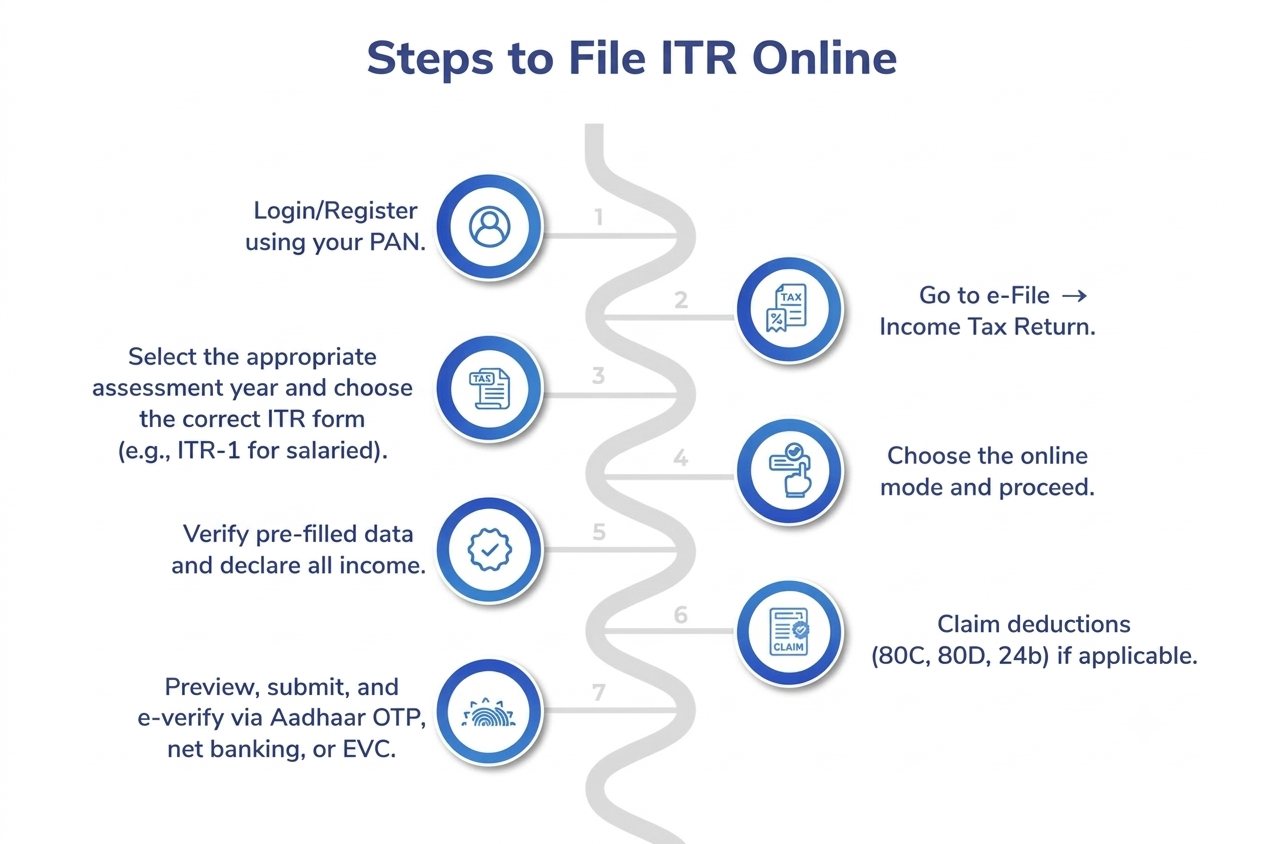
If you are filing your ITR online, make sure you complete the required verification after submission so that your return is properly filed.
Income Tax Filing Frequently Asked Questions
What happens if I miss the ITR deadline?
You can file a belated return, subject to applicable late fees and interest. However, certain benefits, such as carrying forward some losses, may be affected.
Can I revise my ITR after filing?
Yes, you can revise your ITR within the applicable time limit if you find any errors or omissions.
Is ITR filing mandatory for salaried individuals?
Not always. It depends on your total income and other conditions specified under the Income Tax Act.
Can I file ITR without Form 16?
Yes, you can file your ITR using other available records, such as salary slips, AIS, and Form 26AS, to verify your income and tax details.
