
Table of Contents
Employees today are more stressed, disconnected, and emotionally exhausted than ever before. In many workplaces, people hesitate to share concerns, managers struggle with effective workplace communication, and employees often feel that their efforts go unnoticed. As a result, this creates low employee morale, poor employee engagement, burnout, and even a toxic workplace culture that directly impacts both employees and overall business performance.
According to Salesforce Research, employees who feel their voice is heard are 4.6 times more likely to feel empowered to perform their best work. This highlights how open communication and an inclusive workplace culture directly influence employee engagement, productivity, and organizational performance.
This is exactly where employee feedback in workplace culture becomes extremely important. When organizations actively listen to employees and improve internal communication, they gradually build a transparent, positive, and feedback-driven workplace culture. In this blog, we will explore the importance of employee feedback, its impact on workplace culture, and how organizations can create healthier, more engaged, and highly productive workplaces.
What Is Workplace Culture and Why Does It Matter?
Workplace culture is the environment created by an organization through its values, communication style, leadership, and daily work practices. It shapes how employees feel at work, how they interact with each other, and how they respond to responsibilities. A positive workplace culture makes employees feel supported, respected, and motivated, while a weak culture can lead to confusion, stress, and low engagement.
It impacts both employees and the organization as a whole. When workplace culture is strong, employees work better as a team, communicate openly, and stay more productive. As a result, businesses see better performance, higher employee satisfaction, and lower turnover.
Why Is Workplace Culture Important?
Workplace culture plays a crucial role in shaping how employees feel, communicate, and perform every single day. In fact, it directly influences employee motivation, collaboration, and overall organizational success.
However, when employees constantly experience poor communication, lack of appreciation, excessive workload pressure, or unclear expectations, it gradually affects employee morale, engagement, and productivity. Consequently, employees begin to feel emotionally disconnected from the organization.
Employees Stay Longer in Positive Work Cultures
Today, many employees prioritize a healthy workplace culture over salary alone. Specifically, a supportive work environment that encourages transparency, recognition, and open communication helps employees feel valued and respected. On the other hand, a toxic workplace culture often leads to stress, burnout, and higher employee turnover rates.
According to iHire’s Talent Retention Report, cited by SHRM, 32.4% of employees who left their jobs identified a toxic or negative work environment as the leading reason for quitting, ahead of poor leadership and compensation. This reinforces the importance of building a healthy workplace culture to improve employee retention.
Employee Engagement Starts With Feeling Heard
In addition, employees perform significantly better when they feel heard and valued. A workplace that encourages trust, recognition, and open communication naturally improves employee engagement and morale.
However, when employees work in stressful or disconnected environments, they tend to do only the minimum required work because they no longer feel emotionally invested in the organization. As a result, productivity, innovation, and team performance decline over time.
According to Deloitte, companies with strong workplace culture and high employee engagement are more likely to achieve better business performance and employee satisfaction. Therefore, employees today expect transparency, flexibility, appreciation, and meaningful communication—not just job security.
Workplace Culture Impacts Business Growth
Furthermore, poor workplace culture does not only affect employees—it significantly impacts overall business performance as well. Communication gaps, low morale, burnout, and employee dissatisfaction eventually lead to reduced productivity and increased hiring and retention costs.
For example, when employees hesitate to share feedback or concerns, small workplace issues often escalate into larger organizational problems. Consequently, teams become disconnected, trust weakens, and collaboration suffers.
In contrast, businesses with a positive workplace culture create an environment where employees feel psychologically safe and motivated to contribute. As a result, this improves employee experience, strengthens leadership transparency, and supports sustainable business growth over time.
How Does Employee Feedback Shape Workplace Culture?
Workplace culture does not improve automatically; rather, it is continuously shaped by what employees experience and how leadership responds to it. Therefore, employee feedback in workplace culture becomes one of the most powerful tools for organizational improvement.
When employees feel heard, they become more open, more engaged, and more connected to the organization. Conversely, when feedback is ignored, the gap between employees and leadership continues to grow.
Employee Feedback Gives Employees a Voice
Many workplace issues remain hidden simply because employees hesitate to speak up. For in stance, some fear judgment, some feel ignored, and others believe that nothing will change even if they share their concerns. This is where structured employee feedback systems make a significant difference. They provide employees with a safe and structured platform to express thoughts about workload, communication, leadership, and workplace challenges. As a result, when employees see that their feedback is being acknowledged and acted upon, it builds trust and strengthens their emotional connection with the organization.
Feedback Helps Leaders Understand Real Workplace Issues.
Additionally, leaders cannot always see what employees experience on a daily basis. Without proper feedback mechanisms, small problems often go unnoticed until they turn into serious issues such as burnout, low morale, or high attrition. Employee feedback helps management clearly understand:
- Where communication is breaking down
- What is affecting employee satisfaction
- How teams feel about workload distribution
- What improvements employees actually want
Therefore, feedback creates clarity and enables leaders to make informed, data-driven decisions instead of assumptions.
Continuous Feedback Builds a Feedback-Driven Culture
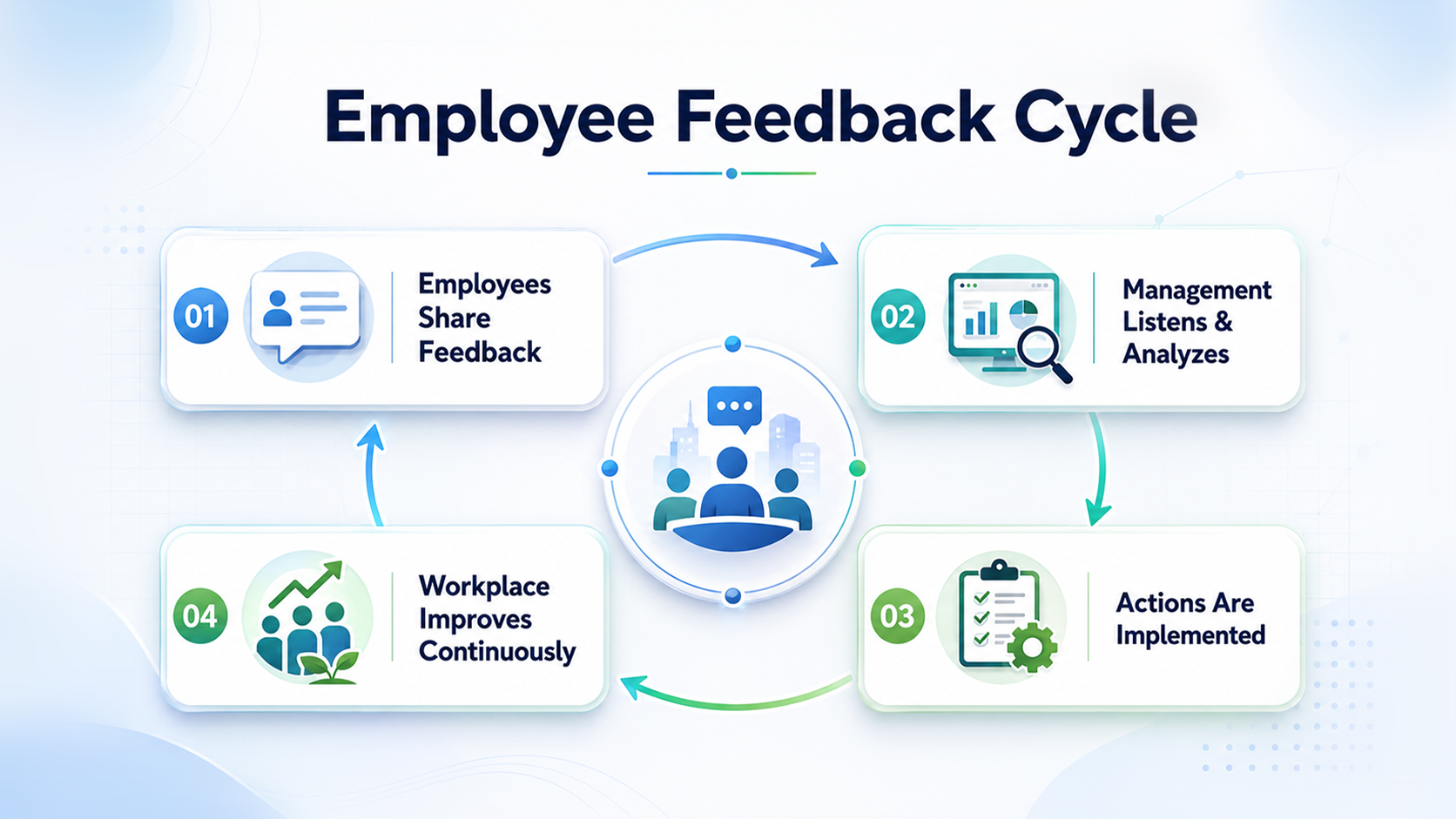
Moreover, workplaces improve faster when feedback is not restricted to annual performance reviews. Continuous employee feedback is an ongoing communication loop between employees and management. Instead of waiting for issues to escalate, organizations can identify concerns early and take corrective action quickly. Consequently, this builds a feedback culture at work where employees feel actively involved in shaping the organization. Over time, this significantly improves trust, transparency, and collaboration across teams.
Employee Feedback Improves Engagement and Retention
When employees observe that their feedback leads to real change, they naturally feel valued and respected. Therefore, this directly improves employee engagement, motivation, and long-term loyalty. Employees are more likely to stay in organizations where their voices are heard. On the contrary, a lack of employee feedback or ignored concerns often leads to frustration, disengagement, and higher turnover rates.
Types of Employee Feedback in the Workplace
Companies collect different types of employee feedback throughout the employee journey to understand how people feel, communicate, and experience the workplace. This helps organizations continuously improve culture, engagement, and internal communication. Along with overall employee sentiment, companies also focus on specific feedback types that capture different aspects of the workplace experience.
1. Engagement-Based Feedback
This feedback focuses on how connected employees feel to their work and the organization. It helps companies understand motivation levels, satisfaction, and overall workplace energy.
2. Quick Pulse Feedback
Pulse feedback is collected in short intervals through small surveys. It captures real-time opinions on workload, communication, and daily work experience, helping companies respond faster to issues.
3. Safe & Anonymous Feedback
This type allows employees to share honest opinions without revealing their identity. It is useful for understanding real concerns that employees may hesitate to express openly.
4. 360-Degree Workplace Feedback
Here, feedback is collected from multiple sides—managers, peers, and team members. It gives a balanced view of how employees collaborate and behave in teams.
5. Continuous Feedback Loop
Instead of waiting for annual reviews, feedback is shared regularly between employees and managers. This keeps communication active and improves transparency at work.
6. Joining & Exit Feedback
This feedback is collected at two important stages—when employees join and when they leave. It helps companies improve onboarding experience and understand reasons for attrition.
7. Day-to-Day Team Feedback
This focuses on daily working relationships between managers and employees or between peers. It helps improve teamwork, communication, and leadership support.
How Can HRMS Tools Support Employee Feedback?
In today’s digital workplace, modern HRMS platforms like DigiSME HRMS software play a crucial role in improving employee feedback systems. Instead of relying on informal conversations, organizations can use HRMS tools to build structured and scalable feedback processes. These tools help businesses to:
- Collect regular employee feedback efficiently
- Track employee sentiment trends over time
- Streamline performance reviews and feedback cycles
- Improve internal workplace communication
- Identify engagement gaps early and proactively
As a result, companies move from reactive decision-making to a more proactive, data-driven approach to employee engagement and workplace culture improvement. Ultimately, this helps organizations build a more transparent, people-focused, and high-performing workplace without unnecessary complexity.
Conclusion
Workplace culture is not built through policies, posters, or formal guidelines—it is built through daily employee experiences, communication quality, and leadership behavior. When employees feel unheard, ignored, or undervalued, it gradually impacts their motivation, trust, and performance. However, when employees feel respected, included, and valued, it creates stronger engagement, better teamwork, and long-term organizational success.
Therefore, employee feedback in the workplace plays a critical role in shaping workplace culture. When organizations actively listen and respond to feedback, they build a culture of trust, transparency, and continuous improvement instead of silence and confusion. Modern HRMS platforms like DigiSME make this transformation easier by enabling continuous employee feedback, improving workplace communication, and turning employee insights into meaningful action. Consequently, companies can shift from guesswork to a truly feedback-driven workplace culture.
If organizations want long-term success, the first step is simple yet powerful: listen to employees consistently—and act on what they say.
Workplace Culture Frequently Asked Questions
How does workplace culture affect employee performance?
Workplace culture influences motivation, communication, and teamwork. A positive culture improves performance, while a negative one reduces productivity and increases stress.
Why is employee feedback important in the workplace?
It helps identify problems early, improve employee experience, and increase engagement by making employees feel heard and valued.
What is a feedback-driven workplace culture?
It is a culture where employee feedback is regularly collected and acted upon to improve trust, communication, and workplace satisfaction.
How do HRMS tools help with employee feedback?
HRMS tools like DigiSME help collect, track, and analyze feedback to improve communication, engagement, and workplace decision-making
