
Table of Content
If you run a small business in India, you’ve probably struggled with leads getting lost in spreadsheets, emails, and WhatsApp chats. As a result, follow-ups slip through the cracks, and valuable sales opportunities vanish — not because your team isn’t capable, but because there’s no central system to manage everything.
However, the good news? You don’t need a complex or expensive CRM to fix this. Today, affordable CRM tools in 2026 help you keep all customer information in one place, automate repetitive tasks, and track leads efficiently, without overwhelming your team or budget.
So, in this blog, we’ll explore the best CRM options for small businesses in India—simple, effective, and easy to use — so you can stay organised, save time, and grow smarter.
Why Your Business Needs an Affordable CRM?
For Indian SMEs, startups, and service businesses, customer engagement isn’t just about follow-ups — rather, it’s about building relationships that convert and retain. However, managing this manually can be challenging. Because of this, leads slip, responses delay, and opportunities vanish. Therefore, here’s why CRM for small business isn’t a luxury anymore—it’s essential.
1. Centralized Customer Hub
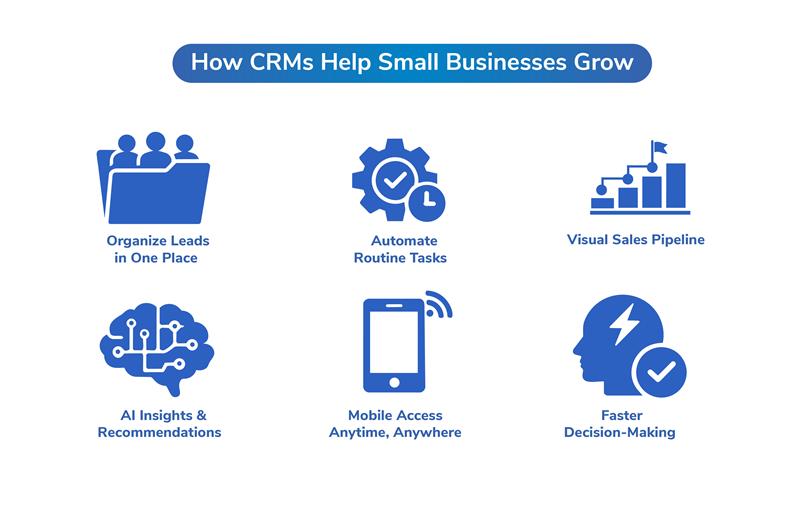
Whether you’re a small business owner in Delhi or a startup founder in Bengaluru, having customer data scattered across spreadsheets, WhatsApp chats, and email threads can seriously slow down your growth. In fact, CRM systems centralize customer information and help teams manage relationships more effectively by bringing everything together in one place—contact details, past communications, sales history, and follow-ups. As a result, nothing gets lost, and your team can stay organized.
2. Automation that Saves Time
In addition, imagine spending less time on manual tasks and more on strategy. Affordable CRM software in India automates repetitive work like:
• Sending welcome emails
• Assigning leads to sales reps
• Scheduling follow-ups
• Tracking customer behaviour
Because of this automation, teams can focus more on closing deals rather than managing tasks.
3. Track Leads Through the Pipeline
Moreover, a CRM helps you track every lead—from first interest to final conversion. You can clearly see which stage a lead is in, what actions were taken, and what needs attention next. Therefore, there is no guesswork and no missed opportunities.
4. Better Customer Engagement
At the same time, Indian customers expect quick and personalized service. A CRM helps your team deliver exactly that with features like email templates, task reminders, and easy-to-read reports, helping businesses manage customer relationships and sales processes more effectively. Consequently, your team can respond faster, work smarter, and build stronger customer relationships — which ultimately leads to higher loyalty and more conversions. So, whether you’re a startup trying to organize your first 100 leads or an SME managing service tickets, a CRM becomes your backbone for customer success.
Top Affordable CRM Software in India (2026)
Today, the Indian CRM market offers a variety of cost-effective solutions that balance features, usability, and pricing. As a result, they are ideal for small businesses, startups, and growing teams. In addition, these tools help you centralize contacts, automate tasks, track leads, and improve customer engagement—without high costs.
1. DigiSME Cloud CRM
First of all, DigiSME Cloud CRM is a purpose-built CRM for Indian SMEs that combines sales, automation, communication, and payments in one platform. Notably, it is especially suited for businesses moving away from spreadsheets and disconnected tools. DigiSME Cloud CRM integrates with email, WhatsApp, Zoom/Teams, popular accounting software, and even ads platforms. Because of these integrations, leads from Google or Meta Ads are auto-captured and routed for follow-ups. Additionally, its built-in AI sales assistant can suggest next steps, draft emails, and provide insights to help small teams stay organised and chase deals efficiently.
Key features
• End-to-end lead & sales pipeline management
• Built-in WhatsApp/email campaigns & reminders
• Quotation, invoicing & payment tracking
• Mobile CRM with GPS & AI recommendations
Best for: SMEs that want an all-in-one CRM workflow without multiple apps.
2. Zoho CRM
Similarly, one of the most popular CRM software in India, Zoho CRM offers a rich feature set and flexible pricing. Importantly, it’s built to grow with your company , from simple contact management to advanced automation and analytics. Furthermore, its AI assistant, Zia, can help you predict trends and automate routine tasks.
Key features
• Lead & deal tracking with customizable pipelines
• Workflow automation & AI insights
• Extensive integrations (600+ third-party apps)
• Mobile app support
Best for: Businesses that want a scalable CRM with strong automation and deep customisation.
3. Freshsales (Freshworks)
Freshsales is known for its intuitive interface and strong sales-focused features. Because of this, it is a solid choice if you want a CRM that’s quick to onboard and easy to use. Additionally, it includes built-in phone and email tools, visual pipelines, and AI-based lead scoring to help you prioritise deals effectively.
Key features
• Visual deal pipelines
• Email/phone integration inside CRM
• AI-driven insights & automation
• Built-in contact scoring
Best for: Small teams that want a simple but powerful CRM with actionable insights.
4. HubSpot CRM
HubSpot remains a popular choice — particularly because its free-forever plan is genuinely usable. For example, it gives startups and solopreneurs basic CRM features without cost. Later, as your business grows, you can unlock more advanced automation and reporting with paid plans. Moreover, HubSpot integrates easily with marketing and content tools.
Key features
• Free CRM tier with core features
• Contact & pipeline tracking
• Email templates & task automation
• Integrations with marketing tools
Best for: New ventures and solo founders testing CRM before investing.
5. LeadSquared
LeadSquared blends CRM with marketing automation. Therefore, it becomes a strong option for businesses that need to capture leads from websites or campaigns and automatically nurture them through workflows.
Notably, it is widely used in education, real estate, and service-oriented industries where lead capture and conversion speed matter.
Key features
• Lead capture & automation
• Nurturing workflows
• Detailed analytics & reporting
• Mobile CRM capabilities
Best for: Businesses that need more than just contact storage — including lead funnel automation.
How to Choose the Right CRM for Your Business?
Choosing an Affordable CRM in India isn’t just about price—instead, it’s about finding the system that fits your team, budget, and growth goals. Ultimately, the right CRM streamlines your workflow, improves customer management, and scales as your business grows.
Define Your Key Needs
Start by understanding what your business truly needs. For instance, consider how many users will access the CRM, whether WhatsApp or SMS communication is required, and if automated follow-ups are essential. Additionally, check whether it needs to integrate with your existing tools like email, website forms, or accounting software. By doing this, knowing these needs upfront helps narrow down your options.
Pricing and Value
Next, cost matters, but value matters more. Instead of focusing only on the lowest price, evaluate monthly fees, free trial periods, and hidden costs such as setup or training. In the long run, the right CRM should deliver features and efficiency that justify its price, saving time and effort.
Usability for Your Team
Even the best CRM is useless if your team struggles with it. Therefore, choose one with an intuitive dashboard, easy lead entry, activity tracking, and a reliable mobile app. Furthermore, let your team test demos and provide feedback to ensure smooth adoption.
Integration Ecosystem
Another important factor is integration. Your CRM should integrate seamlessly with essential tools, including email, website forms, WhatsApp APIs, and accounting software. As a result, systems with native integrations save time, reduce errors, and make daily operations more efficient.
Support and Training
Likewise, strong support is crucial, especially for small teams. Therefore, look for providers offering local support in India, onboarding resources, tutorials, and active community forums. This way, a CRM with reliable support ensures your team can resolve issues quickly and maintain productivity.
Weigh Pros and Cons
Finally, every CRM has advantages and drawbacks. For example, businesses gain a centralized view of customers, faster responses, and better reporting. However, they may also face learning curves, scaling costs, or complexity in advanced features. Thus, a balanced evaluation ensures you pick a CRM that simplifies your workflow rather than complicates it.
Conclusion
Choosing the best CRM software in India in 2026 means balancing features, ease of use, and affordability. Whether you’re just starting with a CRM for startups in India or scaling an SME, the options above deliver real value without heavy investment.
Among these options, DigiSME CRM stands out for Indian small businesses seeking powerful yet simple tools designed for local needs. Specifically, with features like automation, pipeline visibility, and user-friendly dashboards — and without the complexity larger systems bring — DigiSME CRM helps teams capture leads, engage customers, and grow smarter.
So, ready to transform your customer management and unlock sustainable growth? Explore DigiSMECRM today — your affordable gateway to organized sales processes, stronger customer relationships, and measurable business success.
CRM Software Frequently Asked Questions
Do CRMs require technical skills?
No. Most are user-friendly with intuitive dashboards and mobile access. Advanced features are optional.
Can a CRM improve customer engagement?
Yes. CRMs centralize information, automate tasks, and help your team respond faster and smarter, boosting satisfaction and conversions.
Can a CRM integrate with other business tools?
Yes. Most CRMs connect with email, accounting software, website forms, and messaging platforms to streamline daily operations.
Can I access a CRM on mobile?
Most modern CRMs have mobile apps, so you can manage leads, track pipelines, and communicate with customers on the go.
