If You’re in HR or Finance, You Already Know What the End of Month Looks Like. Employee expense claims, reimbursements, missing receipts, delayed approvals, last-minute payroll changes — all of it shows up at once. What should’ve been a simple routine turns into a mad rush against the deadline.
And it’s not just an operational headache. Delayed expense reimbursements make employees lose trust. Manual errors mess with payroll accuracy. And your HR team ends up spending its time chasing approvals instead of doing work that actually matters. A lot of companies are still stuck using spreadsheets, emails, and paper receipts, which only makes things worse.
That’s exactly where a proper claims management software stops being a nice-to-have and becomes something you actually need.

Table of Contents
Why End-of-Month Employee Expense Claims Become Difficult?
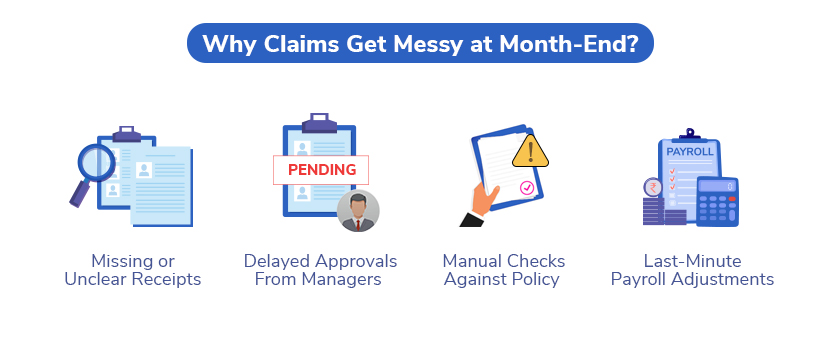
This chaos doesn’t come out of nowhere — it’s usually what happens when your expense reimbursement process is scattered across too many tools and steps. Each issue looks small on its own, but put them together, and the whole system just breaks down when it matters most.
In fact, industry research shows manual expense reports cost an average of $58 to process, take around 20 minutes each, and nearly 19% of them have errors that need extra time and money to fix.
Manual claim submissions
Most employees submit expense claims over email or in spreadsheets, attaching scanned receipts or phone photos taken weeks after the expense. So details get missed, formats are all over the place, and HR ends up verifying everything by hand.
Delayed approvals
Managers usually get a pile of claims right at month-end. Without one central system, approvals get delayed, forgotten, or buried in someone’s inbox. And that slows down both expense reimbursements and payroll.
Lost or unclear receipts
Paper receipts fade, go missing, or get uploaded in a way that’s hard to even read. So HR keeps following up with employees again and again, which just adds more back-and-forth.
Policy violations
Without any automated checks, expenses that shouldn’t be approved sometimes slip through anyway. HR then has to manually check claim limits, categories, and eligibility — and that’s where mistakes and disputes creep in.
Payroll pressure
And finally, approved claims need to match up with payroll at the last minute. Manual entry at this stage increases the chance of wrong payouts, which leads to unhappy employees and compliance headaches. ADP points out that organizations can cut down on these delays and improve payroll accuracy simply by setting up a structured reimbursement process with clear approval steps.
How DigiSME Simplifies Employee Expense Claims?
Handling claims at month-end can get stressful fast. But DigiSME changes that by digitizing and automating the whole process. Employees can submit claims from one platform and upload receipts right away, which cuts down on delays and mistakes. On top of that, smart OCR technology pulls out the data automatically, so there’s a lot less manual entry and fewer errors.
Approvals are automated too, with real-time alerts going straight to managers — so they can approve claims even from their phone. Built-in policy rules stop invalid claims before they become a problem, which means fewer disputes. Meanwhile, both employees and HR can track expense claims in real time, so there’s way less chasing and follow-up.
And here’s the part that really helps at month-end—approved claims flow straight into payroll automatically, so there’s no scrambling to make it all add up.
Key benefits include:
- Quick and accurate claim approvals
- Reduced HR and finance workload
- Fewer payroll errors
- Transparent claim tracking for employees
With DigiSME, month-end claims are no longer stressful. Instead, the entire process becomes faster, smoother, and fully controlled.
Benefits of a Stress-Free Claim Process
Processing employee expense claims every month can feel like running through a maze—missing receipts, delayed approvals, last-minute payroll fixes, the whole cycle. But once you bring in a digital claims system like DigiSME, that monthly chaos turns into something a lot more manageable. Here’s what actually changes.
1. Faster Reimbursements and Satisfied Employees
The biggest, most noticeable change is speed. Employees don’t need to hand in paper receipts or wait days to hear back. With mobile submission and real-time tracking, claims move fast. So employees get paid back on time, which builds trust and cuts down on the constant “any update on my claim?” messages that eat up HR’s day.
2. Reduced Workload for HR and Finance Teams
Manual expense claim processing takes time, and it’s easy to get wrong. HR and finance teams often spend days at month-end checking receipts, verifying claims, and following up with managers. DigiSME takes over the routine parts — scanning receipts, checking policy — so there’s less room for error. That frees up HR to actually focus on things like employee engagement instead.
3. Increased Accuracy and Compliance
A smoother claim process also means fewer mistakes. Automated policy checks make sure only eligible expenses get approved, so you’re not dealing with violations after the fact. The built-in approval workflow keeps things consistent too, so nothing slips through unnoticed. That keeps you compliant and avoids awkward disputes over rejected or miscalculated reimbursements.
4. Real-Time Transparency and Insights
Digital claim platforms give you dashboards that show exactly what’s pending, approved, or rejected — so employees and managers always know where things stand. HR and finance can also spot bottlenecks early and fix delays before they pile up. That kind of visibility builds accountability and takes away a lot of the usual anxiety around claims.
Industry experts agree on this too — digitizing finance workflows helps cut down manual effort, gives better visibility into financial operations, and supports stronger compliance through standardized processes. Deloitte points to this as a key part of broader finance transformation efforts.
5. Seamless Payroll Integration
And finally, automated claims connect directly with your payroll software. So approved claims show up correctly in salaries, there’s less reconciliation work, fewer delayed payments, and month-end closing becomes a lot less painful.
Conclusion
End-of-month claim stress is not inevitable — it’s a sign of outdated systems. Manual processes, scattered approvals, and last-minute reconciliation create unnecessary pressure for HR, finance, and employees alike. With DigiSME’s digital claims management solution, organizations move from chaos to control. Claims are submitted on time, approved faster, aligned with policy, and seamlessly integrated into payroll — without panic or pressure. The result is a stress-free month-end, happier employees, and HR teams free to focus on what truly matters.
Ready to eliminate end-of-month claim chaos? Switch to DigiSME Claims Management Software and experience a faster, simpler, stress-free claims process.
Employee Expense Frequently Asked Questions
Is DigiSME suitable for small and growing businesses?
Absolutely. DigiSME is designed for SMEs as well as growing organizations with scalable needs. This flexibility ensures businesses of any size can streamline their claim process.
How does DigiSME help employees submit claims faster?
Employees can submit claims digitally and upload receipts directly using the app, eliminating paperwork or manual forms. As a result, claim submissions become faster and more accurate.
Can employees track their reimbursement status?
Yes. Employees get real-time visibility into claim status, which reduces follow-ups and uncertainty. Therefore, both employees and HR teams stay informed throughout the process.
