
Table of Contents
Every year, the same questions come up in offices across India. Will Diwali fall on a weekend? Is there a long weekend in March? Employees want to book trips early, while HR teams need to plan attendance, payroll and deadlines around the calendar.
People often search “is today a public holiday” to check whether offices are closed. The answer depends on where you work. A holiday in Chennai may be a normal working day in Pune, and a festival that closes government offices may not apply to a private company at all.
This guide covers the full list of public holidays in 2027 with dates and days, the long weekends, and which holidays private companies follow. It also shows how HR teams can plan leave early, so the next public holiday doesn’t arrive as a surprise.
Public Holidays in India 2027: Complete List
The central government has notified 17 public holidays for 2027, covering 16 separate dates. The first is Republic Day on Tuesday, 26 January. The last is Christmas on Saturday, 25 December. Eleven of the 16 dates fall on weekdays.
This follows the holiday order issued by the Department of Personnel and Training (DoPT) on 16 July 2026. The order covers central government offices in Delhi. Banks, schools and many private companies use it as the base for their own calendars.
| Month | Holiday | Date and day |
| January | Republic Day | 26 January, Tuesday |
| March | Id-ul-Fitr | 10 March, Wednesday |
| March | Holi | 23 March, Tuesday |
| March | Good Friday | 26 March, Friday |
| April | Ram Navami | 15 April, Thursday |
| April | Mahavir Jayanti | 19 April, Monday |
| May | Id-ul-Zuha (Bakrid) | 17 May, Monday |
| May | Buddha Purnima | 20 May, Thursday |
| June | Muharram | 16 June, Wednesday |
| August | Independence Day and Id-e-Milad | 15 August, Sunday |
| August | Janmashtami | 25 August, Wednesday |
| October | Gandhi Jayanti | 2 October, Saturday |
| October | Dussehra | 9 October, Saturday |
| October | Diwali | 29 October, Friday |
| November | Guru Nanak Jayanti | 14 November, Sunday |
| December | Christmas | 25 December, Saturday |
February, July and September have no central holidays, which makes them good months for big projects. March is the busiest, with three weekday holidays. Five dates fall on a weekend (15 August, 2 October, 9 October, 14 November and 25 December), so a five-day work week gets no extra day off from them.
What Is the Difference Between National, Central Government and State Holidays in India?
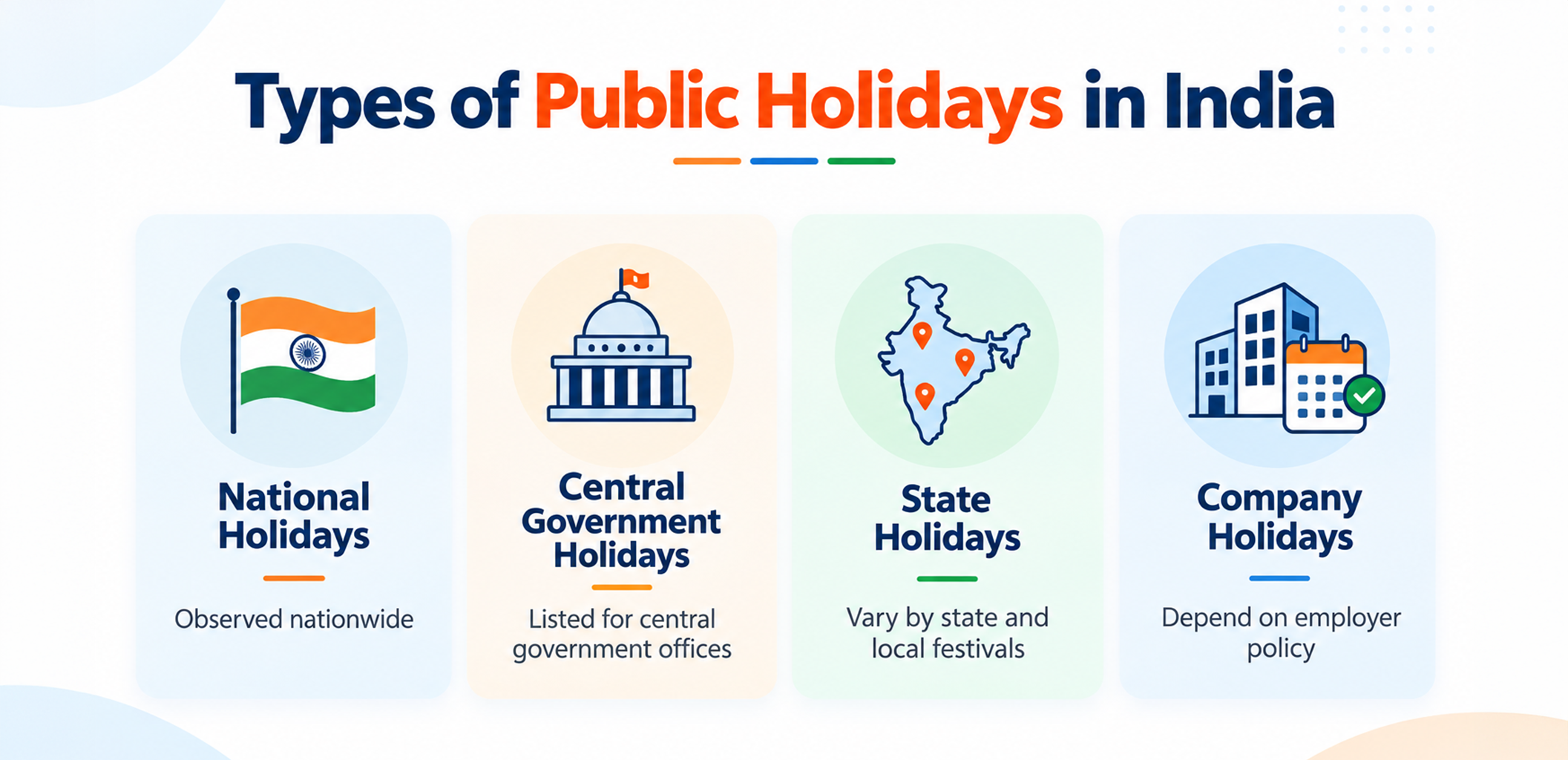
Not every holiday you see on a list applies to your office. Holidays come from three levels, and your actual days off depend on all three.
1. National holidays (same for everyone)
India has only three: Republic Day (26 January, Tuesday), Independence Day (15 August, Sunday) and Gandhi Jayanti (2 October, Saturday). Every employer follows them, including private companies. In 2027, only Republic Day takes away a working day, because the other two fall on a weekend.
2. Central government holidays (a reference list)
This is the 17-holiday list in the table above. Holi, Diwali, Id-ul-Fitr and Christmas all come from this list. It is made for central government offices, and these festivals are not national holidays by law. Plenty of banks, schools and companies copy it, but nobody forces them to.
3. State and company holidays (what applies to your office)
Then come the state lists, which add local festivals like Pongal in Tamil Nadu, Onam in Kerala, Bihu in Assam and Durga Puja in West Bengal. This is why an office in Chennai can be shut on a day when one in Pune is hard at work.
Where to check your list: Use your state labour department’s website or the official gazette. Some 2027 state lists may still be awaiting publication, so recheck later in the year.
Long Weekends in India in 2027
Four long weekends need no leave at all, and a fifth applies where New Year’s Day is observed.
| Dates | Holiday | Days off |
| 1 to 3 January | New Year’s Day | 3 (Friday to Sunday) |
| 26 to 28 March | Good Friday | 3 (Friday to Sunday) |
| 17 to 19 April | Mahavir Jayanti | 3 (Saturday to Monday) |
| 15 to 17 May | Bakrid | 3 (Saturday to Monday) |
| 29 to 31 October | Diwali | 3 (Friday to Sunday) |
*Only where 1 January is observed. Where Diwali is observed on 28 October, that break stretches to four days.
With one leave day:
- 25 January (Monday): four days around Republic Day, Saturday to Tuesday.
- 22 March (Monday): four days around Holi, Saturday to Tuesday.
- 16 April (Friday): five days from Ram Navami to Mahavir Jayanti, Thursday to Monday.
- 21 May (Friday): four days around Buddha Purnima, Thursday to Sunday.
With two leave days: Id-ul-Fitr (Wednesday, 10 March), Muharram (Wednesday, 16 June) and Janmashtami (Wednesday, 25 August) can each become a five-day break by taking Thursday and Friday off.
How HR Teams Can Plan Employee Leave for 2027?
Quick answer: Planning leave is easier in three steps: set the holiday list, spot the busy dates and share everything early.
Step 1: Set the holiday list
Start with one question: where does the team work? Each state has its own holidays, so an office in Chennai and an office in Pune need separate lists.
Then decide three simple rules and write them down:
- Weekend holidays: Christmas falls on a Saturday in 2027. Will employees get another day off, or not?
- Optional holidays: Will employees get a few days to choose, for festivals not on the official list?
- Working on a holiday: Will the employee get extra pay or a day off in return?
Step 2: Spot the busy dates
Busy dates are the days when many people ask for leave at the same time. Long weekends cause most of them.
Here is a simple example. Holi is on Tuesday, 23 March. Many employees will ask for Monday, 22 March, to get four days off in a row. If four people from a team of ten do this, the team is left with six. A support desk or a delivery team may not manage that.
The months to watch are March, April, May and Diwali week. HR can ask for leave requests early and arrange cover before the rush starts.
Step 3: Share the calendar early
Employees plan trips months ahead, so the holiday calendar should reach them in January, or even December. A late calendar means plans made on wrong dates, last-minute leave requests and confusion about which days are working days.
Conclusion
A holiday calendar is more than a list of dates. For employees, it helps with planning trips, family events and time off. For businesses, it helps HR teams plan staffing, approve leave and prepare for payroll deadlines.
The key is to look beyond the national holidays. Regional festivals, state-specific rules and weekends can all affect how your team plans the year. If you manage employees across multiple locations, keeping separate holiday calendars for each state can help avoid confusion.
With DigiSME HRMS, HR teams can manage employee leave, attendance and payroll records alongside their holiday planning. This makes it easier to keep employee records up to date as the year progresses.
Public Holidays Frequently Asked Questions
How many public holidays are there in India in 2027?
The central government list has 17 holidays. Independence Day and Id-e-Milad share 15 August, so there are 16 separate dates. Eleven fall on weekdays. The final number for an employee depends on the state and the company.
Which months have no public holidays in 2027?
February, July and September have no holidays on the central government list. State lists may add days in those months.
When is the public holiday in India in 2027?
The first public holiday in 2027 is Republic Day, on Tuesday, 26 January, though some companies also give 1 January off for New Year’s Day. The last one is Christmas, on Saturday, 25 December. Other big holidays are Holi on 23 March, Independence Day on 15 August, Gandhi Jayanti on 2 October and Diwali on 29 October. Your state and your company may have a slightly different list, so check your own calendar too.
Do private companies in India follow the same holiday list?
Usually not. Private companies follow the holiday list of the state where the office is registered, plus any extra days the company adds. The central government list is only a reference.
Is it a public holiday today in India?
Public holidays in India vary by state and occasion. National holidays are observed across the country, while other holidays depend on central or state government notifications and individual company holiday calendars. Check the relevant official holiday list to confirm whether a particular date is a holiday in your area or workplace.
