
Managing teams today is no longer about supervising people sitting a few desks away. Instead, it’s about leading individuals you may never see in person, yet relying on them to deliver critical results every day. As a result, as organizations expand globally and adopt flexible work models, HRs and managers must ensure teams remain aligned, productive, and accountable—without physical visibility.
According to a 2026 report by NASSCOM, over 58% of Indian IT and service companies now operate with distributed or hybrid teams. Therefore, virtual team management has become a permanent business model. Because of this shift, understanding how HRs and managers can manage virtual teams across the world is essential for modern organizations.
In this guide, practical strategies, real examples, and structured systems are explained to help HR leaders and managers improve remote work management, strengthen cross-cultural communication, and ensure efficient performance tracking in remote teams.

Table of Contents
Challenges of Managing Virtual Teams
Managing distributed teams involves structural and operational challenges that directly impact productivity and employee experience. Therefore, understanding these challenges helps HR leaders design systems that support efficient virtual team management.
Communication Barriers in Remote Team Management
Communication is the backbone of any team, and studies show that poor communication is one of the biggest productivity barriers in remote work environments. In traditional offices, employees clarify doubts instantly. However, virtual teams depend on digital tools, which can delay responses and reduce clarity.
For example, a finance team in Mumbai may send a payroll update at the end of their workday, while a team member in the UAE sees it hours later. As a result, without structured communication, this delay can impact operations.
Therefore, structured communication systems help solve this by organizing conversations into channels, enabling asynchronous workflows, and reducing confusion. Ultimately, the key to effective managing virtual teams is not to increase communication volume but to improve communication clarity and structure.
Managing Remote Teams Across Time Zones
Managing remote teams across time zones is one of the moManaging remote teams across time zones is one of the most complex aspects of global operations, particularly as hybrid work adoption continues to grow across organizations worldwide. In many cases, employees may have only a few overlapping working hours, which affects collaboration speed. Consequently, without proper planning, teams experience:
• Decision delays
• Reduced productivity
• Uneven workload distribution
An HRMS for remote teams can help managers track attendance, working hours, and team availability across locations. Platforms like DigiSME can support this visibility across distributed teams. Moreover, by focusing on outcomes instead of real-time presence, organizations improve efficiency and reduce friction.
Cross-Cultural Communication and Team Alignment
Virtual teams often include employees from different cultural and professional backgrounds. Because of this diversity, differences in communication style, feedback expectations, and work habits can create misunderstandings.
For instance, some cultures prefer direct feedback, while others prefer indirect communication. Without proper awareness, this difference may be misinterpreted. Therefore, HR leaders can address this by creating standardized communication guidelines and promoting inclusive collaboration.
Performance Tracking for Remote Teams
The tricky part about managing remote teams is that you can’t just walk over and see how someone’s doing. There’s no physical visibility. So performance has to be tracked through actual output and system data instead.
That’s where structured communication systems really help. With centralized dashboards, managers can keep an eye on attendance, productivity trends, and performance indicators — all in one place. And when that kind of transparency exists, it naturally builds more trust between employees and management too.
Best Practices for Virtual Team Management
Putting structured systems in place helps HR leaders get better coordination, productivity, and engagement out of their teams. Here are a few proven practices that really make a difference — focused on communication, alignment, and performance tracking.
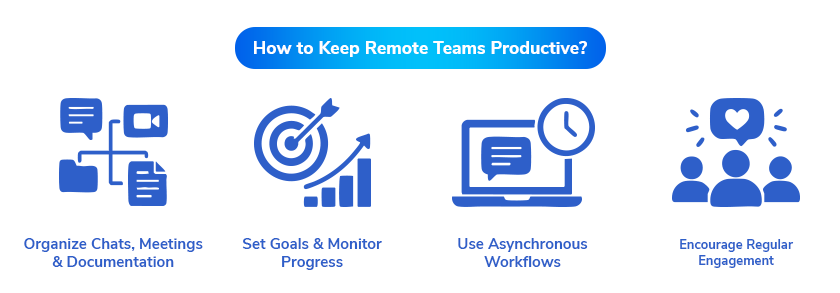
Establish Clear Communication Systems
Here’s a problem a lot of teams run into: conversations scattered across five different chat threads, and nobody knows where the actual decision was made. That’s what happens without a proper communication setup. The fix is simple — use one central platform, and decide exactly what it’s for.
Tools like Zoho Cliq and Zoho Meeting help with this. Cliq lets teams organize conversations into channels instead of one messy group chat, and Zoho Meeting takes care of scheduled discussions that actually get documented. But the tool alone doesn’t fix things — managers also need to set some ground rules. Chat is for quick updates. Meetings are for actual discussions. Documentation is for anything that’s a decision. Once that’s clear, things stop getting delayed, and everyone can find the information they need without having to ask around.
Align Goals Using Project Management Systems
When responsibilities aren’t clearly assigned, work just stalls—not because people aren’t willing, but because nobody’s sure who’s supposed to do what by when. So managers need to assign tasks, set clear timelines, and actually track how things are moving, instead of hoping it all comes together.
This is where something like Zoho Projects helps. Managers can assign work, see exactly where things stand, and keep visibility even when the team is spread across different locations. The result? Employees know what’s on their plate without being told twice, and managers don’t have to keep chasing updates. That’s really what good remote employee management comes down to—people owning their work because the system makes it clear, not because someone’s constantly checking in.
Use Asynchronous Workflows to Improve Productivity
Not every task needs an instant reply. That’s the whole idea behind asynchronous workflows — employees get things done on their own time, without waiting around for someone to respond right away. This matters a lot when your team is spread across different cities or time zones.
For example, an HR manager in Chennai can assign a task through a project system, and employees sitting in other locations can pick it up whenever it fits their schedule. No one’s stuck waiting. Work keeps moving, delays go down, and the whole team can function smoothly, round the clock.
Track Performance Using Data Instead of Assumptions
Remote team management requires objective performance visibility. Therefore, managers should monitor structured metrics such as task completion, attendance consistency, and overall productivity trends.
In addition, attendance and workforce management platforms like DigiSME help track employee activity, attendance, and performance visibility. Consequently, this enables managers to make informed decisions, identify gaps early, and maintain operational transparency.
Strengthen Virtual Team Engagement
When a team works remotely, it’s easy for people to start feeling disconnected. No hallway chats, no quick check-ins — just work, work, work. That’s why engagement matters even more with remote teams, not less. Regular team meetings, a bit of recognition when someone does well, and keeping communication transparent — these small things add up. When people interact regularly, trust builds naturally, collaboration gets easier, and the team stays stable over time. End result? A virtual team that stays productive, stays aligned, and actually feels accountable — even when everyone’s sitting in different cities.
Checklist: Global Virtual Team Management
This checklist helps HRs and managers implement effective virtual team management immediately:
• Ensure communication systems are centralized using tools like Zoho Cliq.
• Track attendance and productivity to improve visibility.
• Assign and monitor tasks using Zoho Projects for better alignment.
• Schedule meetings strategically while respecting different time zones.
• Use asynchronous workflows to improve flexibility and efficiency.
• Provide cultural awareness support to improve collaboration.
• Monitor performance regularly using data and dashboards.
• Recognize employee contributions to improve engagement.
Conclusion
Managing virtual teams successfully requires structured communication, clear goal alignment, and reliable performance visibility. When these systems are implemented, teams stay productive, accountable, and connected regardless of location.
In this regard, DigiSME makes this process easier by providing accurate attendance tracking, real-time workforce visibility, and centralized management in one platform. As a result, instead of relying on manual follow-ups or assumptions, HR teams can monitor performance, maintain transparency, and ensure smooth operations.
Start optimizing your virtual team management today with DigiSME and build a more productive, connected, and scalable workforce.
Virtual Team Management FAQs
What are the biggest remote team challenges?
Communication barriers, time-zone differences, and performance visibility are the most common challenges.
What are the best Indian tools for managing virtual teams?
Indian tools such as DigiSME, Zoho Projects, Zoho Cliq, and Keka help manage communication, productivity, and performance efficiently.
Why is virtual team management important for modern organizations?
It enables companies to access global talent, improve flexibility, and increase productivity.
How can DigiSME help HRs manage virtual teams?
DigiSME helps HR teams track attendance, monitor productivity, and manage distributed teams efficiently from a centralized dashboard.
