If you’re an employee or in an HR/payroll team, the choice between the old vs new tax regime 2026 can feel overwhelming. Indeed, one wrong decision can cut your take‑home salary by a large amount each year. Moreover, recent reports show that around 88 % of individual taxpayers in India have already switched to the new regime, highlighting how many are choosing simplicity and lower rates over complex exemptions.
Therefore, in this guide, we’ll break down the Old vs New Tax Regime India 2026, explain how it affects salaries, deductions, and payroll, and provide practical tips for both employees and HR teams.

Table of Contents
What Is a Tax Regime in India?
In India, employees can choose between two tax regimes: the old tax regime and the new tax regime. Both determine the income tax payable on taxable income, but they differ in tax rates, deductions, and exemptions.
Old Tax Regime
The old tax regime allows various deductions and exemptions, such as HRA, Section 80C, and health insurance deductions. It may be suitable for employees who have eligible investments, expenses, or allowances that can reduce their taxable income.
New Tax Regime 2026
The new tax regime has different tax slabs and allows fewer deductions and exemptions than the old regime. It provides a simpler way to calculate tax, particularly for employees with fewer eligible deductions.
Key Difference:
In short,
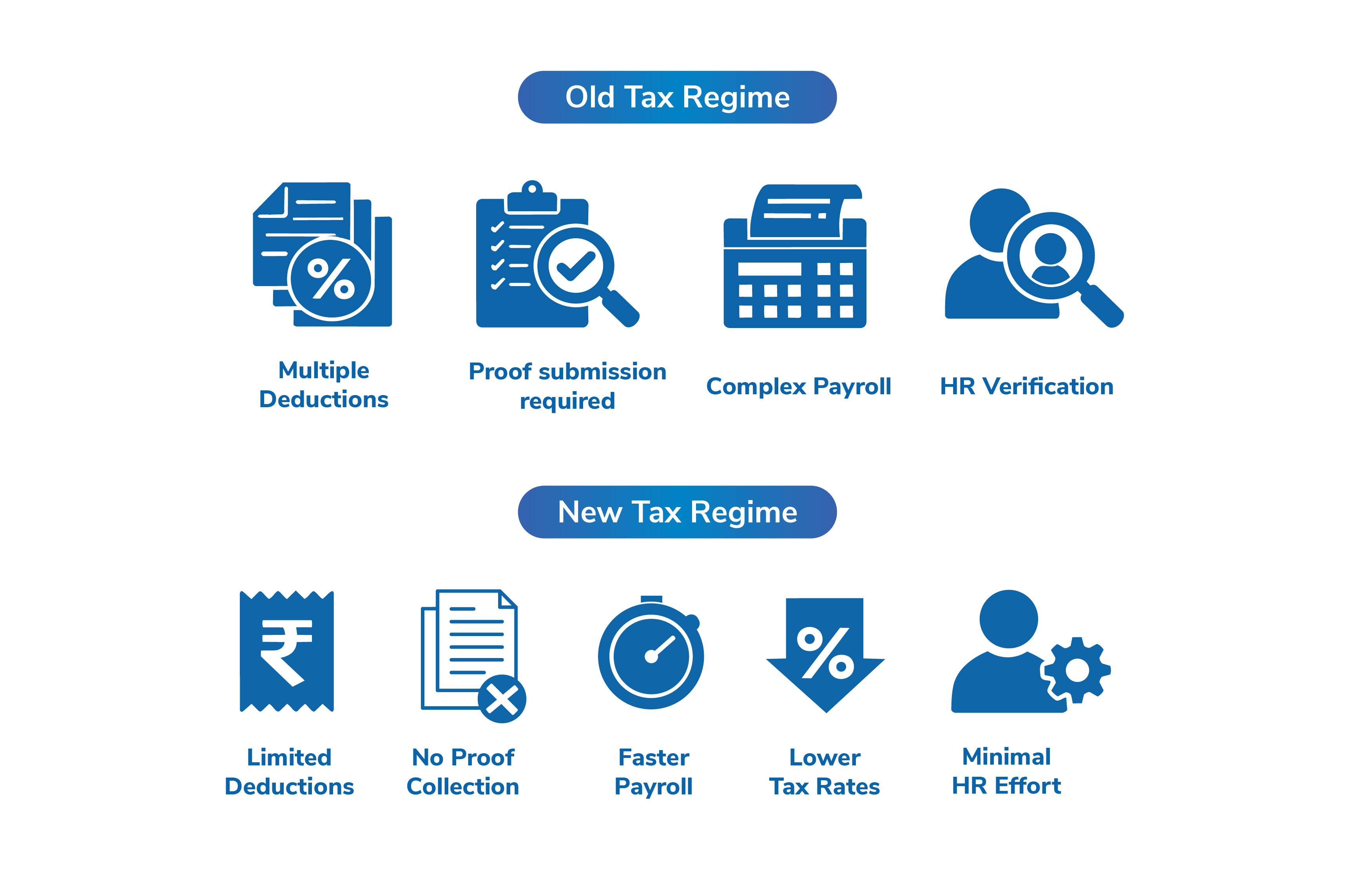
- Old regime = more paperwork, more exemptions, possibly lower tax if you have deductions.
- New regime = fewer deductions, simpler calculations, faster approvals in HRMS.
What Are the Income Tax Slabs for 2026?
Understanding the income tax slabs under the old and new tax regimes helps employees estimate their tax liability and plan salary deductions. For HR and payroll teams, knowing these slabs also helps with accurate TDS calculations.
For FY 2026–27 (AY 2027–28), the income tax slabs depend on the tax regime you choose. The new tax regime is the default option, but eligible taxpayers can opt for the old regime.
Income tax slabs determine the tax rate applied to different portions of your taxable income. The tax slabs remain unchanged between FY 2025–26 and FY 2026–27 under both regimes.
New Tax Regime 2026 – Slabs & Rates
Therefore, the new tax regime 2026 offers lower tax rates across more income levels. Moreover, this regime applies fewer deductions and exemptions, making it simpler and often better if an employee has minimal or no tax‑saving investments.
| Taxable Income | Tax Rate |
| Up to ₹4,00,000 | 0% |
| ₹4,00,001 – ₹8,00,000 | 5% |
| ₹8,00,001 – ₹12,00,000 | 10% |
| ₹12,00,001 – ₹16,00,000 | 15% |
| ₹16,00,001 – ₹20,00,000 | 20% |
| ₹20,00,001 – ₹24,00,000 | 25% |
| Above ₹24,00,000 | 30% |
Key Features under New Tax Regime:
- Standard deduction: ₹75,000 for salaried individuals
- Rebate under Section 87A: Makes income up to ₹12 lakh effectively tax‑free
- Most traditional exemptions (like HRA, 80C, 80D) are not allowed here
Thus, this structure is designed to simplify tax calculation and reduce the need for tracking multiple claims. In particular, it’s particularly suitable for employees with fewer deductions.
Old Tax Regime 2026 – Slabs & Rates
Meanwhile, under the old tax regime, taxable income is generally higher because deductions and exemptions are applied before tax. However, the slabs start at a lower taxable income threshold.
| Taxable Income | Tax Rate |
| Up to ₹2,50,000 | 0% |
| ₹2,50,001 – ₹5,00,000 | 5% |
| ₹5,00,001 – ₹10,00,000 | 20% |
| Above ₹10,00,000 | 30% |
Important Notes:
- Standard deduction is ₹50,000
- Deductions & exemptions such as HRA, Section 80C (up to ₹1.5 lakh), 80D, home loan interest, and more can reduce taxable income significantly
- Therefore, the old regime may still be beneficial for employees with higher eligible deductions
Old vs New Regime – High‑Level Comparison
| Feature | Old Tax Regime | New Tax Regime 2026 |
| Default Status | Optional | Default Tax Regime |
| Basic Exemption Limit | ₹2.5 L | ₹4 L |
| Standard Deduction | ₹50,000 | ₹75,000 |
| Rebate Limit (Section 87A) | Up to ₹5 L | Up to ₹12 L |
| Deductions / Exemptions | Allowed (HRA, 80C, 80D, etc.) | Mostly Not Allowed |
| Ease of Calculation | Moderate | Simple |
What Deductions and Exemptions Can Employees Claim?
One major difference between the old vs new tax regime 2026 is what deductions and exemptions an employee can claim. Specifically, these directly reduce your taxable income, which means more money in your pocket. Hence, understanding this is important for both employees and HR teams.
Read Also: Tax Declaration to ITR Filing: A Complete Guide for Employees in India 2026
Old Tax Regime – What You Can Claim
The old tax regime gives you many ways to reduce your taxable income if you invest or spend on certain things. For instance, common claims include:
- Standard Deduction – ₹50,000 for salaried employees
- Section 80C – Up to ₹1.5 lakh for investments like: EPF, PPF, Life insurance premiums, ELSS funds
- House Rent Allowance (HRA) – Part of your rent can be tax-free
- Health Insurance (80D) – Premiums paid for yourself or family
- Home Loan Interest – Up to ₹2 lakh per year
- Leave Travel Allowance (LTA) – Travel expenses within India
- Other deductions: Education loan interest (80E), Donations (80G), Savings interest (80TTA), Employee NPS, Book Fees Allowance, Mobile/Internet Allowance, Tuition Fees
New Tax Regime 2026 – What You Can Claim
The new tax regime 2026 is simpler but allows fewer deductions. Therefore, it’s best for employees with fewer investments or allowances.
You can claim:
- Standard Deduction – ₹75,000 for salaried employees
- Rebate under Section 87A – Makes income up to ₹12 lakh mostly tax-free
- Employer NPS Contribution – Allowed under 80CCD(2)
However, you cannot claim:
- Section 80C investments (PPF, ELSS, LIC, etc.)
- Health insurance deduction (80D)
- HRA
- Home loan interest
- LTA and most other allowances (cleartax.in)
Quick Comparison
| Deduction / Exemption | Old Tax Regime | New Tax Regime 2026 |
| Standard Deduction | ₹50,000 | ₹75,000 |
| 80C Investments | Allowed (up to ₹1.5L) | Not Allowed |
| Health Insurance (80D) | Allowed | Not Allowed |
| HRA | Allowed | Not Allowed |
| Home Loan Interest | Allowed | Not Allowed |
| Section 87A Rebate | Lower limit | Higher benefit |
How Tax Regime Choice Impacts Payroll?
When an employee chooses between the old vs new tax regime 2026, it doesn’t just affect their personal taxes; in addition, it changes how HR teams calculate payroll, manage documents, and ensure tax compliance. Therefore, this section explains these payroll effects in a simple way so HR and payroll professionals can plan better.
1. Tax Deduction at Source (TDS) Depends on the Regime Chosen
Firstly, employees must tell HR which regime they want for the year because employers calculate TDS based on that decision. However, if an employee doesn’t communicate a choice, most companies deduct tax using the new tax regime 2026 by default. Hence, payroll teams must collect this information early in the year to avoid incorrect tax deductions.
With DigiSME HRMS, this process becomes easier; for example, the system automatically captures employee regime selection and calculates TDS accordingly without manual intervention, thereby reducing errors from the start.
2. Old Regime Means More Documentation for HR
Under the old tax regime, employees claim various tax deductions India 2026 and exemptions like:
- Section 80C proofs (PPF/ELSS/LIC, etc.)
- HRA and rent receipts
- Health insurance receipts (80D)
- Home loan interest statements
Consequently, HR or payroll teams must verify these proofs and enter them into the HRMS payroll engine. Although this makes the calculation more accurate, it increases administrative work, especially during investment declaration season.
Impact: Collecting proofs each year adds workload, increases review time, and demands stronger tracking systems.
3. New Tax Regime Means Simpler Payroll Processing
In contrast, the new tax regime benefits HR teams by simplifying payroll calculations:
- Lower tax slabs and standard deduction are taken automatically
- Fewer proofs to collect
- Less chance of errors in exemptions
- Payroll becomes faster and more predictable
Because fewer deductions and exemptions are allowed, HR teams don’t need to validate proofs for many items, thus reducing payroll complexity dramatically.
4. Cash Flow and Take‑Home Salary Changes Need Communication
Naturally, your choice of tax regime affects an employee’s take‑home salary 2026 every month:
- Under the new regime, lower slab rates often translate to higher monthly take‑home pay for employees with few deductions.
- Under the old regime, employees with many exemptions may reduce their annual tax liability, but this doesn’t always reflect in monthly take‑homepay unless calculated correctly.
Therefore, HR should run comparative simulations and share them so employees see how payroll changes if they choose differently.
5. Payroll Systems Must Be Updated for Compliance
Additionally, payroll systems (HRMS) must be configured to handle both regimes correctly. Moreover, the system must support updates if employees change regimes while filing tax returns (though most choose it once per financial year). Also, Invoices and Forms 16 must align with the regime used for TDS calculation so that mismatches and compliance issues are avoided.
6. End‑of‑Year Reconciliation Matters
Even though monthly TDS may be correct, some employees may end up with excess TDS or tax due at year‑end:
- Excess tax deducted may lead to refunds
- Lower deduction may result in additional tax payable
Hence, payroll teams should guide employees accordingly and also remind them that income tax filing must be completed within the due date (usually July) to avoid penalties or delays. With DigiSME HRMS, year-end tax summaries are generated automatically, therefore helping both HR and employees understand any differences before filing returns.
Impact on Take‑Home Salary: Real Examples
Deciding between the old vs new tax regime 2026 can directly affect how much money employees actually receive in their salary every month. Let’s break it down in a simple way with examples.
1. How Regimes Affect Take‑Home Salary
Old Tax Regime: Best for employees who have multiple deductions, like HRA, 80C, 80D, or home loan interest. It can lower your overall tax, but calculating monthly take-home requires careful accounting.
New Tax Regime 2026: Fewer deductions are allowed, yet tax rates are lower and calculation is simple. Thus, employees with minimal deductions often get higher monthly take-home. Consequently, payroll is easier for HR too.
2. Example – Few Deductions
Imagine an employee earning ₹9,00,000 per year with only the standard deduction.
| Regime | Taxable Income | Approx Tax | Take-Home Salary |
| Old | ₹8,50,000 | ₹67,500 | ₹8,32,500 |
| New | ₹8,25,000 | ₹41,250 | ₹8,58,750 |
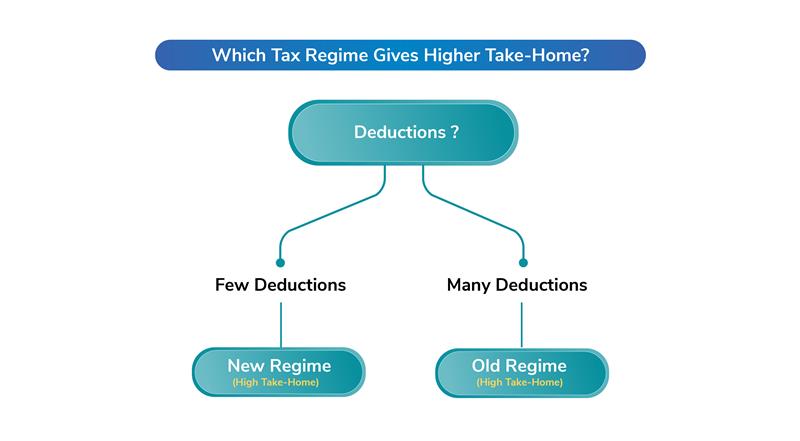
Takeaway: With few deductions, the new regime gives slightly higher monthly take-home salary.
3. Example – Many Deductions
Now, consider an employee earning ₹15,00,000 with these deductions:
- 80C ₹1.5 lakh
- 80D ₹50,000
- HRA ₹2 lakh
- Home loan interest ₹2 lakh
| Regime | Taxable Income | Approx Tax | Take-Home Salary |
| Old | ₹9,00,000 | ₹97,500 | ₹14,02,500 |
| New | ₹15,00,000 | ₹2,12,500 | ₹12,87,500 |
Takeaway: Employees with many deductions usually benefit more under the old regime, even though the calculation is more complex.
What Are the Benefits and Drawbacks for Employees and HR Teams?
Choosing between the old vs new tax regime 2026 affects both employees and HR teams. Therefore, understanding the pros and cons helps everyone make smarter decisions.
1. For Employees
Old Tax Regime:
Benefits: The old tax regime gives you more tax deductions and exemption s in 2026. If you have investments or eligible expenses, it can lower your taxable income a lot. It’s especially helpful for employees who have HRA, home loans, or health insurance claims.
Drawbacks: On the downside, you need to collect proofs and calculate your taxes carefully. Also, your payroll and monthly take-home can be a bit more complicated, and there’s usually more paperwork when filing your ITR at the end of the year.
New Tax Regime 2026:
Benefits: The new tax regime offers lower tax rates with a simpler structure, so that your monthly take-home can be higher without worrying about collecting proofs. Additionally, It’s easier to manage for employes who prefer less paperwork and a straightforward salary calculation.
Drawbacks: However, you lose most exemptions and deductions, thus if you have investments, HRA, home loans, or health insurance claims, your overall tax savings may be lower compared to the old regime.
2. For HR & Payroll Teams
Benefits of the New Tax Regime for HR: Payroll becomes simpler and faster, requiring less proof collection and document verification, therefore reducing the chance of errors in TDS calculation.
Drawbacks of the Old Tax Regime for HR: It requires verifying multiple proofs (like HRA, investments, and health insurance), which makes monthly payroll calculations more complex, and increases workload as well as the risk of mistakes in TDS or Form 16.
Conclusion
Ultimately, choosing between the old vs new tax regime 2026 affects both take-home salary and payroll management. Generally, employees with many deductions usually benefit from the old regime, while those with simpler finances may prefer the new regime for its ease and faster calculations. Similarly, for HR teams, the new tax regime simplifies payroll, reduces paperwork, and helps ensure accurate TDS, whereas managing the old regime requires more effort and proof collection.
Using smart payroll software like DigiSME makes handling both regimes easier. In fact, DigiSME allows HR and Finance teams to manage all investment proofs digitally, with approval or rejection after proper verification. Furthermore, it offers a comparison tool that helps employees understand which tax regime suits them best and shows the tax difference, making it easier to choose the right option. With automated TDS calculation, proof management, and accurate salary computation, DigiSME saves HR time and helps employees receive the correct take-home salary.
Explore DigiSME to simplify payroll and tax regime management for your team.
Tax Regime Frequently Asked Questions
What is the difference between old and new tax regimes in India 2026?
The old tax regime allows various deductions and exemptions like HRA, Section 80C, 80D, and home loan interest, which can reduce taxable income. The new tax regime offers lower tax rates but fewer exemptions, making it simpler and easier to manage monthly take-home salary.
Which tax regime is better for salaried employees in 2026?
Employees with multiple deductions and investments usually benefit more from the old tax regime, while those with simpler finances may prefer the new tax regime for its ease of calculation and reduced paperwork.
Can employees switch tax regimes during the year?
No, employees cannot switch tax regimes during the financial year. The choice between old and new tax regimes must be made at the start of the year or during the annual payroll declaration period.
What deductions are allowed under the old tax regime?
Under the old tax regime, employees can claim deductions like HRA, Section 80C (up to ₹1.5 lakh), Section 80D (health insurance), home loan interest, and other eligible expenses to lower taxable income.
Does choosing a tax regime impact TDS?
Yes, the choice of tax regime affects TDS calculation. Payroll systems calculate TDS based on the selected regime, and incorrect selection may lead to under- or over-deduction of taxes. Using smart payroll software can simplify this process.
